AEC’s plumbing contractors pressure-test every concealed pipe run before a single tile goes down, and apply cementitious waterproofing under every wet-area floor and wall junction, under PEC Licence No. 17347, Category C4/E. Most bathroom leaks in Karachi don’t announce themselves where they start. They travel sideways through the slab and surface two floors down, as a stain on someone else’s ceiling, months after the pipe first began to weep.
The pattern repeats across Karachi’s older apartment blocks. New tile goes in, the paint dries, everyone moves on. Three or four months later, the flat below reports a damp patch spreading across the ceiling, and nobody upstairs has seen a drop of water in their own bathroom.
Get a Plumbing Quote — Free Site Assessment Included
AEC delivers plumbing works in Karachi for new construction, renovation, and institutional projects — water supply, drainage, and sanitary installation across commercial and government contracts, under PEC-licensed supervision.
Why the Leak Never Shows Where It Starts
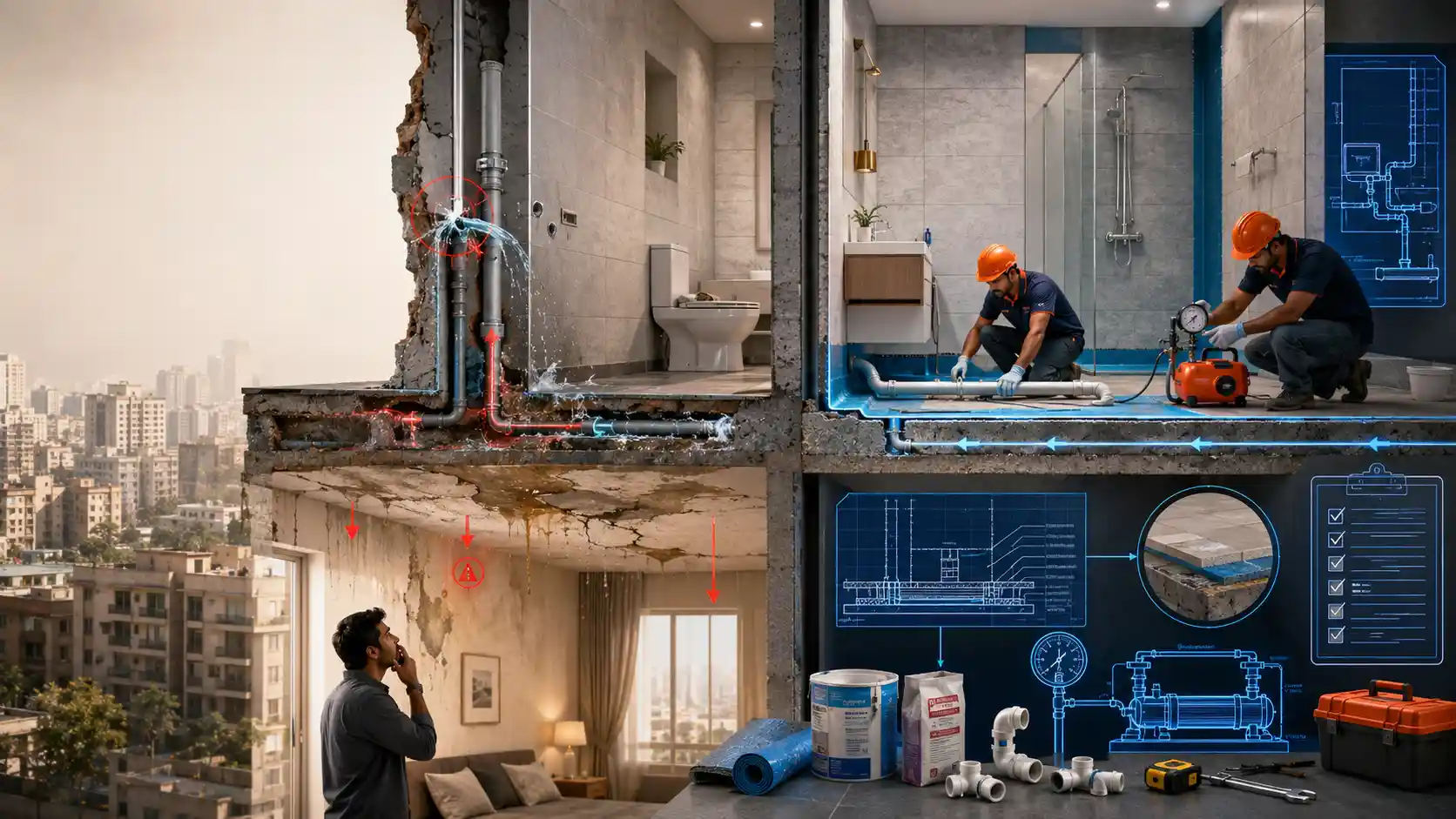
A bathroom wall or floor hides its pipework inside concrete, brick, or block, sealed under plaster and tile. When a joint starts weeping, water rarely drops straight down. It spreads sideways through the slab, following rebar and construction joints, until it finds a crack or a porous patch to surface through.
By the time a stain appears below, the leak has usually run for weeks. The concrete slab, the masonry between units, and sometimes the electrical conduit near the pipe run have all sat in moisture that whole time. This is why the same leak so often turns into a dispute between neighbours in a multi-story building. The unit above sees nothing wrong inside its own walls. The unit below is staring at a spreading stain with no way to trace where it started.
The Two Root Causes Behind Almost Every Concealed Leak
Mismatched or Low-Grade Pipe and Fittings
UPVC pipe is joined with solvent cement, and that joint is only as reliable as the surface prep and the installer’s technique on the day it was made. Cheap pipe walls, low-grade cement, and rushed joint work all raise the odds of a slow weep at a joint rather than a sudden burst. Mixing pipe or fittings across brands compounds the risk, since tolerances between manufacturers aren’t guaranteed to match.
Concealed Layouts Installed Without Testing
The bigger problem is procedural, not material. A line gets routed through a wall, connected, and plastered over the same day, with nobody confirming the joints hold pressure before they disappear from view. Once tile goes on, a marginal joint becomes invisible until it fails. Opening the wall to find it then means breaking finished work to reach it.
UPVC vs PPRC: Which Pipe Actually Holds Up
| Factor | UPVC / PVC | PPRC |
|---|---|---|
| Joint method | Solvent cement, quality-dependent | Heat fusion welding, continuous bond |
| Best suited for | Cold water supply, waste and vent lines | Hot and cold water supply |
| Joint failure risk | Higher with poor cement or prep | Lower once fusion-welded correctly |
| Upfront cost | Lower | Higher, generally fewer repairs later |
| Concealed work | Needs pressure testing regardless of grade | Needs pressure testing regardless of grade |
Both materials perform when installed and tested correctly. Neither belongs behind plaster untested, whatever grade is written on the invoice.
How AEC Pressure-Tests a Line Before Any Wall Closes
AEC fills every new plumbing line with water, pressurises it to roughly one and a half times its normal working pressure, and holds that pressure while checking for any drop. Water doesn’t compress the way air does, so a pressure drop during the hold points straight to a leak or a weak joint. Testing plastic pipe with air instead isn’t accepted under major plumbing codes — it’s less reliable and carries its own safety risk if a fitting fails under load.
The sequence, in order:
- Complete the full pipe layout — supply and waste — before any concealment work starts.
- Fill the system with water, letting trapped air escape through open valves or fittings.
- Pressurise to the required test level with a hydrostatic pump.
- Hold for the specified duration and monitor for any drop.
- Inspect every joint visually for seepage during the hold.
- Repair or replace any joint that fails, then repeat until the line holds clean.
- Only then does the wall or floor get plastered, screeded, or tiled.
Cementitious Waterproofing: The Layer Nobody Sees Once Tiling Starts
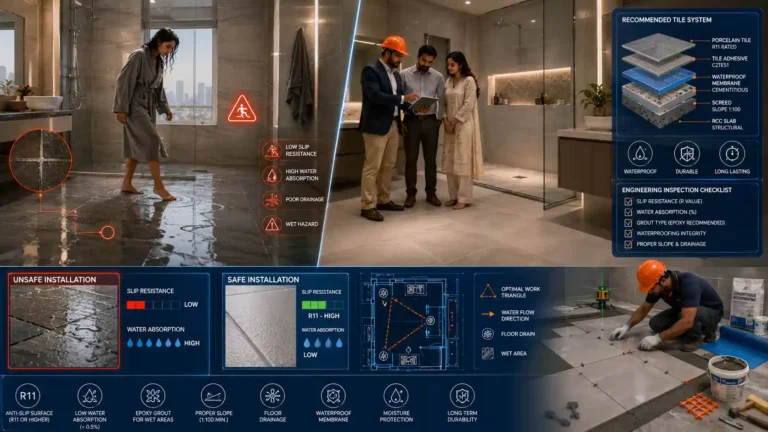
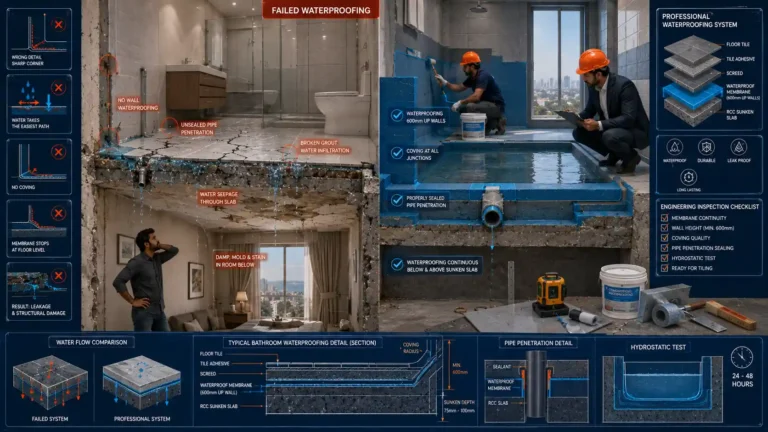
Tile and grout aren’t waterproof on their own. Grout lines are porous, and a hairline crack in a floor or wall lets water track straight through to the structure behind it. A proper wet-area spec always puts a dedicated waterproofing layer under the tile, not just the tile itself. AEC applies a cementitious coating in two to three coats onto the prepared substrate before any adhesive goes down — the same tanking principle used in international wet-room tiling standards, where the membrane is the actual water barrier and tile is just the wear surface above it.
Details AEC treats as non-negotiable on every wet area:
- Waterproofing runs at least 150 millimetres up the wall at every wall-to-floor junction — the single most common leak origin point in a bathroom.
- Reinforcement tape gets embedded at every internal corner, wall-floor junction, and pipe penetration, bridging the small movement gaps a plain coating can’t hold on its own.
- Every pipe penetration gets sealed individually. A coat applied around an unsealed sleeve leaves the exact gap water is looking for.
- The floor gets flood tested — filled with water and left standing — before tiling begins, confirming the membrane holds before it disappears under a permanent finish.
Warning Signs of a Hidden Leak
- A ceiling stain or paint bubble in the room directly below a bathroom
- A persistent damp or musty smell near a bathroom wall with no visible water
- Tiles that sound hollow when tapped, suggesting the adhesive bond has failed underneath
- A water meter that keeps turning slowly with every tap and fixture closed
- Mould or discolouration along grout lines despite regular cleaning
- Paint or plaster on an adjoining wall softening or bubbling for no obvious reason
How a Bathroom Renovation Should Actually Be Sequenced
AEC finalises the full pipe layout and material spec before any pipe enters a wall — a layout decided mid-installation forces rushed joints and awkward routing. Supply and waste lines get installed and hydrostatically tested as one complete system, not piece by piece, since a partial test can miss a fault that only shows up once the whole line is pressurised together. Once plumbing passes, the substrate gets prepared for waterproofing — cleaned of dust and loose material — before the coating goes on with reinforcement tape at every junction. The floor gets flood tested before tile work starts. Only after plumbing and waterproofing have each independently passed does tiling begin, since tiling is the step that makes both systems invisible and unreachable without demolition.
This sequencing sits at the core of AEC’s bathroom renovation service in Karachi, which folds plumbing inspection and pressure testing into every renovation scope rather than treating them as an add-on once tile work is already underway.
What Testing and Waterproofing Add to the Budget
Pressure testing and cementitious waterproofing add a modest amount to a bathroom fit-out, since both are labour and material steps already folded into a standard plumbing and tiling schedule rather than a separate project line. Skipping them saves a small amount upfront and risks a bill many times larger later — fixing a concealed leak after tiling means breaking out finished walls or floors, replacing damaged tile, repairing the affected structure, and in a multi-story building, making good the ceiling of the unit below as well. AEC quotes both as standard line items on every bathroom renovation and new plumbing installation, not as optional extras.
Why AEC for Plumbing and Bathroom Renovation in Karachi
AEC holds PEC Licence No. 17347, Category C4/E, covering the civil and mechanical works scope that plumbing and waterproofing both fall under. The company applies the same tested, documented process to a single bathroom renovation as it does to institutional plumbing work for clients including NED University of Engineering & Technology and Jinnah Sindh Medical University. Every line AEC installs gets pressure tested before concealment, and every wet area gets cementitious waterproofing before tiling, regardless of project size.
Get a Plumbing and Waterproofing Assessment
Contact Advanced Engineering & Construction — Bathroom Renovation in Karachi
Plan Your Bathroom Renovation — Get a Free Site Visit
AEC handles bathroom renovations in Karachi from design to handover — plumbing fixtures, wall and floor tiling, waterproofing, and complete remodels under PEC-licensed supervision.
Frequently Asked Questions
Why does a bathroom leak show up in the ceiling below instead of inside the bathroom itself?
Water from a concealed pipe or floor leak spreads sideways through the concrete slab and masonry before it finds a crack or porous point to surface through. By the time a stain appears below, the leak has usually been active for weeks inside the structure.
Is PPRC pipe always better than PVC for bathroom plumbing?
PPRC’s fusion-welded joints are generally more consistent than PVC’s solvent-cement joints, but either material performs reliably when installed correctly and pressure tested before concealment. The bigger risk factor is skipping the test, not the pipe grade on the invoice.
Can waterproofing be added after the tiles are already installed?
Not without removing the tile first, since cementitious waterproofing has to sit directly on the substrate, underneath the tile and adhesive layer. That’s exactly why it needs to be done correctly the first time, before tiling begins.
How much does pressure testing and wet-area waterproofing add to a bathroom renovation cost?
Both add a modest amount to the overall project cost, since they use materials and labour already part of a standard plumbing and tiling schedule. The cost of skipping them — tearing out tile and repairing structural water damage later — runs far higher.
Is AEC PEC-licensed to handle plumbing and waterproofing in multi-story buildings?
Yes. AEC holds PEC Licence No. 17347, Category C4/E, covering the civil and mechanical works scope required for plumbing installation and wet-area waterproofing in residential and institutional buildings alike.
What should I do if I suspect a leak from my bathroom is affecting my neighbour’s ceiling?
Get the plumbing line and the wet-area membrane inspected together, since the fix usually needs a pressure test to locate the pipe fault and a waterproofing check on the floor and wall. Addressing only one of the two often leaves the underlying problem unresolved.