
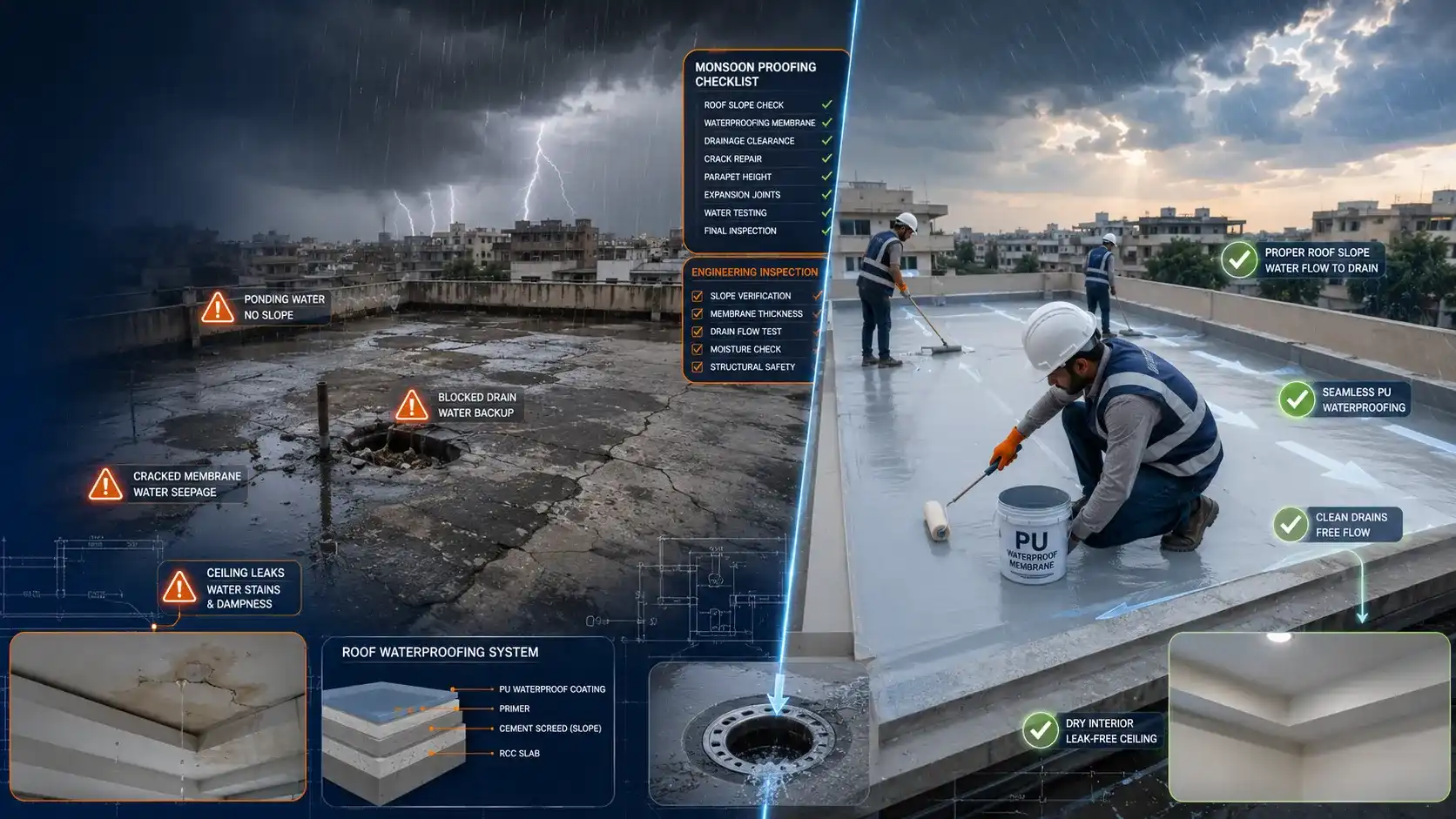
Advanced Engineering & Construction inspects and waterproofs flat roofs across Karachi under PEC Licence No. 17347, Category C4/E, correcting structural slope before applying any waterproofing membrane. In a single 2025 monsoon spell, the Met Office recorded 149.6 millimetres of rain in Nazimabad in one day, with Gulshan-e-Iqbal, Gulistan-e-Jauhar, and surrounding sectors hit by comparable volumes. A flat roof built without proper drainage slope holds that water for days, not hours, and every extra hour of standing water pushes moisture further into the ceiling below.
Why Karachi’s Flat Roofs Pool Water Every Monsoon
Most residential and commercial construction in Karachi uses flat RCC roofs, poured level or close to level at the time of construction. A genuinely flat roof has no built-in path for water to leave. Industry standards call for a minimum fall of roughly a quarter inch per foot, about 2 percent, so gravity pulls water toward a drain instead of leaving it to sit. Many Karachi roofs were cast without this fall ever being calculated, and even roofs built with a slope lose it over time as the slab deflects slightly under its own dead load and years of added weight from water tanks, cooling units, and rooftop storage.
Karachi’s monsoon arrives as intense, short-duration downpours rather than steady rainfall spread across the day. Strong monsoon currents move in from the Arabian Sea and the Bay of Bengal and drop heavy rainfall in a matter of hours, overwhelming a roof surface that was already struggling to drain in light rain. Once water sits on a roof for more than 48 hours, it is officially classed as ponding rather than normal wet-weather runoff, and ponding is where real structural and interior damage begins.
Blocked or undersized roof drains make the problem worse. Karachi’s rooftops collect dust, construction debris, and monsoon-blown leaves for months between rains, and a drain outlet clogged even partially cannot discharge water fast enough during a sudden downpour. Water backs up behind the blockage and spreads across the roof surface instead of leaving it.
What Ponding Water Actually Does to a Building
Standing water is not a cosmetic problem. It is a structural load, a chemical exposure, and a slow membrane killer, all at once.
Added structural weight.
A single inch of standing water across a typical roof adds meaningful dead load the slab was not designed to carry indefinitely, and that added weight increases slab deflection, which in turn creates a slightly lower point where water collects even more the next time it rains.
Membrane breakdown.
Traditional bitumen sheet membranes soften under prolonged water contact and heat cycling, and repeated wet-dry cycles cause the sheet to lose adhesion at the seams first, which is exactly where leaks start.
Interior damage.
Once water finds a weak seam or a hairline crack in the roof slab, it tracks down through the concrete and shows up as a damp patch, a paint bubble, or a full ceiling stain in the room below, often days after the rain has already stopped.
Signs Your Roof Needs Attention Before This Monsoon
- Visible puddles still sitting on the roof surface 48 hours after the last rain
- Ceiling paint bubbling, peeling, or showing a yellow-brown tide mark
- Cracked or curling bitumen sheet at the seams, especially near parapet edges
- A damp, musty smell in the top-floor room after rainfall
- Water pooling consistently in the same low spot every time it rains
- Moss, algae, or dark staining concentrated in one section of the roof
The AEC Solution: Correct the Slope Before You Coat the Roof
A waterproofing membrane, however good, is being asked to hold back standing water indefinitely if the roof underneath has no slope to shed it. AEC treats slope correction as the first job on any monsoon-proofing project, not an optional upgrade.
Structural slope correction (screeding and grouting).
AEC lays a graded screed, sometimes called grouting in local practice, over the existing roof slab to build in a positive fall toward the drain outlets. This screed is a cement-sand or lightweight concrete layer applied thicker at the high points and tapered down toward each drain, correcting years of flat or reverse-falling roof surface in one pass. Where a roof has multiple low points, AEC uses two-way or four-way falls, or a small raised cricket near obstructions like water tanks, so no single area is left without a path to a drain.
Elastomeric polyurethane membrane over the corrected slope.
Once the fall is right, AEC applies a liquid-applied elastomeric polyurethane (PU) membrane rather than a traditional bitumen sheet. PU forms a seamless, fully bonded coating that cures into a flexible, rubber-like layer able to bridge hairline cracks that develop in the slab beneath it. PU systems bring genuine crack-bridging and elongation properties along with resistance to chemicals and UV exposure, which matters directly on a roof that sits under Karachi’s sun for ten months of the year before facing the monsoon.
Why PU outperforms bitumen sheet on Karachi’s flat roofs:
| Factor | Bitumen Sheet Membrane | Elastomeric PU Membrane |
|---|---|---|
| Application method | Torch-applied or self-adhesive rolled sheet, seamed at joints | Liquid-applied, forms one continuous seamless layer |
| Seam risk | Every joint is a potential leak point over time | No seams across the roof field |
| Flexibility under Karachi’s heat cycling | Stiffens and can crack as it ages under sun exposure | Stays flexible and bridges minor slab cracks as they form |
| Behaviour under ponding water | Loses adhesion at seams under prolonged standing water | More tolerant of intermittent standing water during peak monsoon flow |
| Typical service life before major repair | Shorter under repeated heat and moisture cycling without recoating | Longer where surface prep and slope are both correct |
| Best suited for | Budget-constrained repairs, below-grade and foundation work | Exposed flat roofs, terraces, and any surface facing direct monsoon rain |
Bitumen membrane still has a place, particularly for foundation and below-grade waterproofing where AEC’s approach follows Section 15’s material guidance for that application. For an exposed Karachi rooftop taking direct monsoon impact every year, the seamless, flexible nature of PU is the better match for the actual failure pattern this climate produces.
The Monsoon Roof-Proofing Checklist
Run through this before the rains hit, whether you’re doing a full waterproofing job or a maintenance check on an existing roof.
- Clear every roof drain and downspout of dust, leaves, and construction debris before the first monsoon spell.
- Check for standing water 48 hours after any rain shower; if it’s still there, the slope needs correction, not another coat of sealant.
- Inspect parapet-to-roof junctions for cracked or lifted sealant, since this is where water most often tracks back into the structure.
- Look at existing bitumen sheet edges for curling, blistering, or brittle cracking, particularly around seams.
- Confirm the roof has a working fall toward at least one drain; a roof that looks flat to the eye usually is, structurally.
- Get a structural assessment before recoating if ceiling stains or paint bubbling are already visible, since surface coating alone will not stop water already tracking through the slab.
How AEC Executes a Monsoon Roof-Proofing Project
AEC starts with a site survey to map existing low points and confirm drain locations, since correcting slope without this step risks creating new low spots instead of removing them. The existing roof surface is then cleaned and any old, failing membrane is stripped back to the base slab. Screeding follows, built up in graded layers to create the calculated fall toward each outlet, with cricket details added around water tanks, AC units, or any rooftop obstruction that would otherwise trap water on its uphill side. Once the screed cures, the PU membrane goes on in multiple coats, since a single thin coat leaves pinholes that defeat the purpose of a seamless system. Parapet junctions, pipe penetrations, and drain outlets get reinforced detailing at this stage, since these transition points fail before the open roof field ever does.
Cost Context: What Monsoon Roof-Proofing Adds to a Karachi Budget
Roof waterproofing cost in Karachi depends on whether the job needs slope correction or only a surface coating, and the difference between the two changes the price substantially. Bitumen sheet membrane material alone runs at the lower end of the market, while liquid-applied PU and comparable elastomeric systems sit higher due to the multi-coat application and surface preparation involved. A roof that already has correct slope and only needs re-membraning costs meaningfully less than one requiring full screeding to correct years of flat or reverse-falling surface, since the screed work itself adds labour and material on top of the membrane. AEC quotes each roof individually after the site survey, since roof size, existing slope condition, and the number of penetrations and junctions all move the final number.
Why AEC for Roof Waterproofing in Karachi
AEC operates under PEC Licence No. 17347, Category C4/E, covering civil and structural works including the slab and screed corrections that make roof waterproofing durable rather than cosmetic. The company has delivered civil works for institutional clients including NED University of Engineering & Technology and Jinnah Sindh Medical University, and applies the same structural discipline to residential rooftop work in Gulshan-e-Iqbal, Nazimabad, and Gulistan-e-Jauhar as it does on larger institutional projects. Roof slope correction sits within the same civil scope covered on AEC’s civil construction service page, since grading, screeding, and structural concrete work all draw on the same site team and technical standards.
Already Planning a Renovation?
Roof waterproofing is frequently discovered as an urgent add-on during a broader home renovation, once a top-floor room reveals a ceiling stain the owner had been ignoring. AEC’s home renovation service in Karachi includes a roof and terrace assessment as part of its standard structural review, so slope and membrane condition get checked before finishing work begins rather than after a monsoon exposes the gap.
Get a Roof Assessment Before the Next Downpour
Frequently Asked Questions
What is the minimum roof slope needed to stop water pooling on a Karachi rooftop?
Industry standard calls for a fall of roughly a quarter inch per foot, close to 2 percent, sloped consistently toward a drain outlet. Many Karachi roofs fall short of this because they were cast level at construction, which is exactly why screeding is needed before any membrane goes on.
Why do bitumen sheets crack faster than polyurethane membranes in Karachi’s climate?
Bitumen sheet is seamed at every joint and stiffens under repeated heat exposure, so the seams become the first failure point after a few monsoon cycles. Elastomeric PU forms one continuous, flexible layer with no seams, which handles Karachi’s heat-to-monsoon swing with less cracking.
Is PU roof waterproofing enough without fixing the underlying slope first?
No. A membrane placed over a flat or poorly sloped roof still leaves standing water sitting on top of it, and prolonged ponding shortens the life of any membrane material, PU included. Slope correction and membrane application need to happen together for the fix to hold.
How much does professional roof waterproofing cost in Karachi?
Cost depends on whether the roof needs full screeding to correct slope or only a fresh membrane coat over an already-sloped surface, with the former costing more due to the added structural work. AEC provides a fixed quote after a site survey rather than a flat per-square-foot number that ignores each roof’s actual condition.
Is AEC PEC-licensed to carry out structural roof slope correction?
Yes. AEC holds PEC Licence No. 17347, Category C4/E, which covers the civil and structural scope needed for screeding, grading, and slab-level roof correction work, not only surface-level membrane application.
How long does a polyurethane roof membrane last before it needs reapplication?
Service life depends on correct surface prep, adequate coat thickness, and a properly sloped substrate underneath it, with well-executed systems lasting considerably longer than a rushed single-coat application. Roofs with standing water problems left unresolved will wear out any membrane faster regardless of material quality.