Here’s a scene that plays out in kitchens across DHA and Clifton more often than anyone admits. A homeowner falls in love with quartz online, picks a bright white slab because it photographs beautifully, and installs it right beside the stove. Eight months later there’s a dull, slightly warped patch exactly where the pan lands after coming off the burner. Nobody at the showroom mentioned that.
That’s not a design failure. It’s a placement failure — and it’s the single most common mistake in Karachi kitchen renovations right now.
Most countertop guides treat this as a simple beauty contest. Granite versus quartz versus marble, pick your favorite, done. That advice works fine in a mild, dry climate. It falls apart in Karachi, where you’ve got two hostile forces working on your countertop at once: coastal humidity that never really lets up, and summer heat that turns a stovetop zone into something closer to an oven edge. Get the material-to-location match wrong here, and you’re not looking at a decade of elegant aging. You’re looking at a resealing headache or a cracked resin surface within a year or two.
So let’s actually work through this properly — material by material, zone by zone, and with real numbers instead of vague “it depends.”
Contact Advanced Engineering & Construction — Kitchen Remodeling in Karachi
Plan Your Kitchen Remodel — Get a Free Site Visit
AEC handles kitchen remodeling in Karachi from design to handover — cabinetry, countertops, tiling, plumbing fixtures, and full fit-out under PEC-licensed supervision.
What Each Material Is Actually Made Of (And Why That Matters More Than the Color)
Granite: The Old Reliable Nobody Gets Excited About Anymore
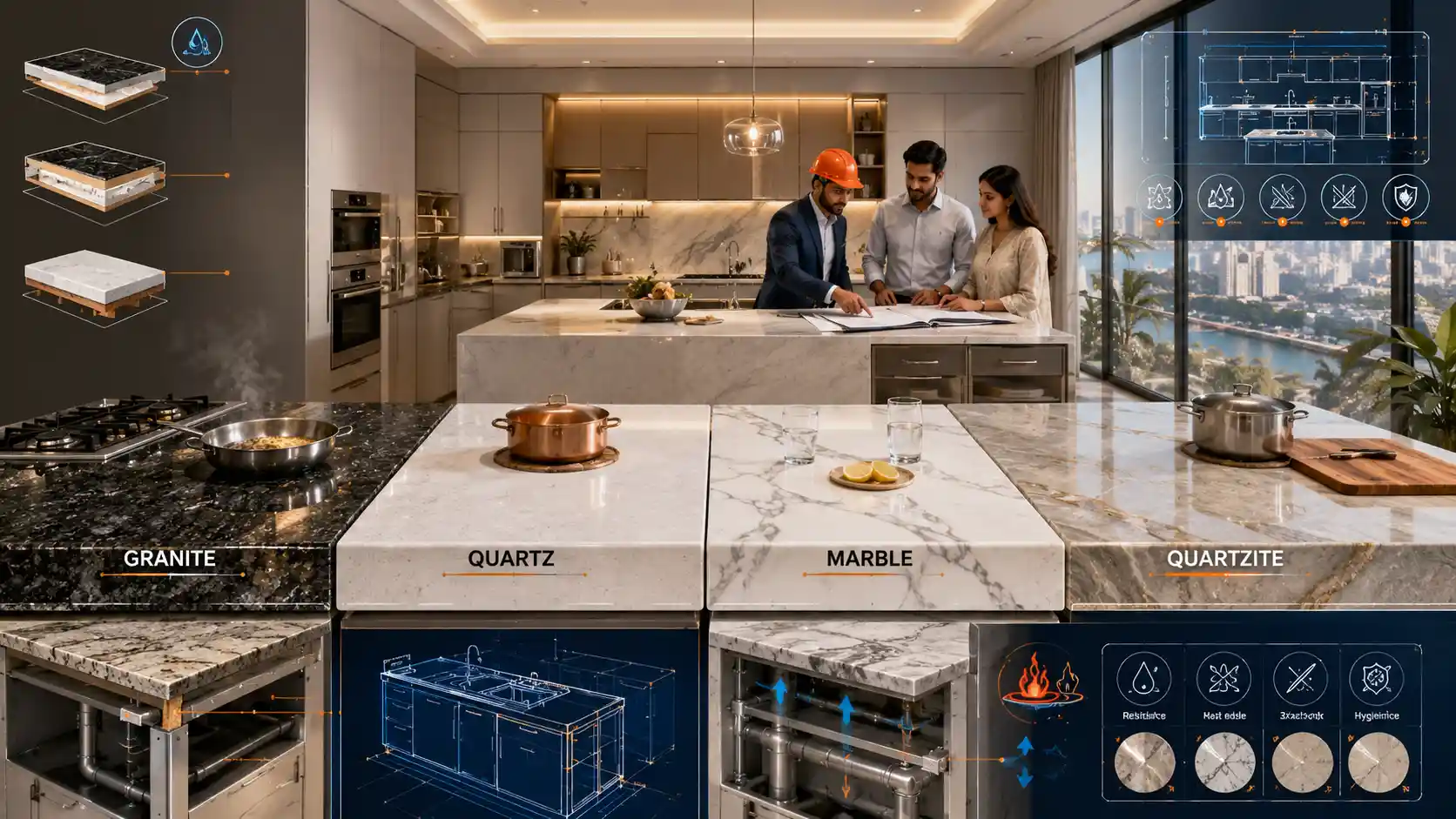
Granite is cooled volcanic rock, and that origin story is exactly why it handles heat so well. It sits at a Mohs hardness of six to seven, tough enough to shrug off daily knife nicks and hot pans without flinching. The catch is porosity. Granite drinks in liquid the way a sponge does, just slower, which means turmeric, oil, and the acidic marinades common in Karachi cooking can leave a stain if the surface isn’t sealed roughly once a year.
Nobody puts granite on a mood board anymore. It’s the countertop equivalent of a Toyota Corolla — unglamorous, occasionally mocked, and still running perfectly when the flashier option has already failed.
Quartz: The Instagram Favorite With One Real Weakness
Quartz isn’t quarried, it’s engineered. Roughly ninety percent crushed natural quartz gets bound together with a polymer resin, and that resin is the whole story here. It’s what makes quartz non-porous — no sealing, ever, no staining from turmeric or tea. It’s also what makes quartz vulnerable to heat. Somewhere around 65 degrees Celsius, that resin starts to discolor or crack. A pan straight off a gas burner clears that number without even trying.
Here’s the part that annoys me about how quartz gets marketed. Every showroom brochure calls it “low maintenance” and “durable,” which is true right up until someone sets a hot pot down on it. The material isn’t lying to you. The sales pitch just leaves out the one detail that actually matters for where you put it.
Marble: Beautiful, Soft, and Not Built for a Working Kitchen
Marble is the showstopper. It’s also the weakest of the four, sitting at a Mohs hardness of three to five, which is soft enough that a dropped cast-iron pan can chip it. It handles moderate heat acceptably, but acidic contact is where marble really struggles — lemon, tamarind, vinegar, all staples of Karachi cooking, will etch a dull mark into marble faster than you’d expect if left sitting even briefly.
If you’ve ever seen a beautiful marble kitchen island with a faint cloudy ring near where someone set down a glass of nimbu pani, that’s not bad luck. That’s marble doing exactly what marble does.
Quartzite: The One Almost No One Asks For
Quartzite is natural stone, formed when sandstone gets compressed under extreme heat and pressure until it turns into something with granite-level hardness and marble’s good looks. True quartzite doesn’t etch from acidic liquids the way marble does, which makes it the quiet overachiever of this list. It’s still porous and needs the same annual resealing granite does, but it handles both heat and daily wear better than anything else on this page.
Most homeowners have never heard of it. That’s partly because it’s harder to source in Pakistan, and partly because “quartzite” sounds close enough to “quartz” that people assume it’s the same thing marketed under a fancier name. It isn’t. Don’t let the name fool you into skipping it.
Why “Just Pick Quartz” Advice Breaks Down in a Coastal City
Karachi’s humidity is the quiet variable most countertop advice ignores entirely. Porous stone — granite, marble, quartzite — absorbs moisture straight out of the air, not just from spills on the counter. That process runs faster here than it does in a drier inland city. A sealant that would comfortably last a full year in Lahore or Islamabad can start wearing thin closer to the eight or nine month mark in a DHA or Clifton kitchen sitting near the sea breeze.
Quartz sidesteps this completely, and that’s the strongest argument in its favor. No sealing, no absorption, no humidity-driven staining risk. If your only concern were moisture, quartz would win this comparison outright, no contest.
But moisture is only half of Karachi’s climate problem. The other half is heat, and that’s where quartz’s advantage evaporates.
The Heat Problem Nobody Mentions Until It’s Too Late
Ambient kitchen temperatures in Karachi routinely climb past 35 degrees Celsius through summer, and that’s before you factor in a lit gas burner or a pan straight off the stove. A quartz countertop sitting close to a hob, or one that catches direct afternoon sun through a window, is living dangerously close to that 65-degree threshold where the resin starts to give.
Granite and quartzite don’t share this problem. Both formed under real geological heat and pressure, so a hot pan resting on either one for a few extra seconds isn’t a crisis. That makes them the more forgiving pick for the zone directly beside the stove, where quartz genuinely struggles.
Marble sits in an uncomfortable middle position — it tolerates moderate heat reasonably well but etches fast if hot oil or an acidic spill lingers on the surface, which in a Karachi kitchen making daily use of lemon and tamarind, happens more than people plan for.
Matching the Material to Where It Actually Sits
This is the piece most guides skip entirely, and it’s the piece that actually prevents the mistake from the opening story.
Beside the hob and in the primary acidic-prep zone: granite or quartzite. Both resist heat and etching better than marble or quartz in exactly this spot.
Island tops, sink surrounds, anywhere away from direct stove heat: quartz performs beautifully here. The non-porous surface handles Karachi’s humidity and daily staining risk without ever needing resealing.
Low-traffic accent surfaces — a baking counter, a decorative island section: marble earns its place here, where its appearance matters more than its resistance to daily abuse.
Treat the kitchen as multiple zones with different demands, not one material choice for the whole room, and most of the regret stories disappear.
What This Actually Costs in Karachi
| Material | Type / Origin | Price per sq ft (slab only) |
|---|---|---|
| Marble | Local varieties (Badal Grey, Sunny White) | PKR 200 – 450 |
| Marble | Premium/imported (Ziarat White and similar) | PKR 500 – 1,200+ |
| Granite | Local/Indian-origin common colors | PKR 300 – 800 |
| Granite | Imported premium (Blue Pearl, Galaxy Black) | PKR 1,500 – 2,000+ |
| Quartz | Imported, engineered | Project-specific quote |
| Quartzite | Imported, natural | Project-specific quote |
A full installed kitchen top around 30 square feet commonly lands in the tens of thousands of rupees, swinging heavily on color and origin. Quartz and true quartzite aren’t stocked locally at anywhere near the volume of marble and granite, so pricing gets quoted per project once the specific slab is sourced rather than published as a flat rate. Anyone quoting you a fixed per-square-foot number for quartz without seeing your kitchen first is guessing.
The Cabinet Mistake Almost Nobody Sees Coming
Kitchen slabs get cut at 2 to 3 centimeters thick, noticeably heavier than the thinner stone used for flooring or wall cladding. That extra thickness matters for durability, particularly around sink cutouts and edge-cutting, where stress concentrates and thinner slabs are far more likely to crack during installation.
What it also means: granite, marble, and quartzite are considerably heavier than quartz, and your base cabinetry has to be strong enough to carry that weight for years without sagging. This is the detail people forget when they’re deep in color-swatch decisions. A gorgeous granite slab sitting on cabinets rated for a lighter surface is a problem waiting to announce itself.
If I Were Renovating My Own Kitchen
Honestly? Granite beside the stove, quartz on the island, and if the budget stretches far enough, quartzite across the whole run so I never have to think about the heat-versus-humidity tradeoff again. Marble would go nowhere near my daily cooking zone — it’s stunning, but it needs a level of babying that doesn’t match how most Karachi households actually cook.
That’s not the “safe” recommendation you’ll get from a showroom trying to move one specific product. It’s the one that matches how the materials actually behave once summer hits and the stove’s been running for an hour.
Contact Advanced Engineering & Construction — Kitchen Remodeling in Karachi
Plan Your Kitchen Remodel — Get a Free Site Visit
AEC handles kitchen remodeling in Karachi from design to handover — cabinetry, countertops, tiling, plumbing fixtures, and full fit-out under PEC-licensed supervision.
FAQ
Which countertop material is best for Karachi’s humid climate?
Quartz handles humidity best since its non-porous resin surface doesn’t absorb moisture from the air the way granite, marble, and quartzite do. Those three porous stones need more frequent sealing here than in drier inland cities.
Can quartz go directly next to a gas stove in a Karachi kitchen?
Not recommended. Quartz resin starts to discolor or weaken above roughly 65 degrees Celsius, a temperature hot cookware reaches easily straight off the burner. Granite or quartzite is the safer call for that zone.
Does marble stain easily with Karachi cooking ingredients like turmeric and oil?
Yes. Marble is the most porous of the four and etches when acidic ingredients like lemon or tamarind sit on the surface. It suits an accent surface far better than a primary prep zone.
How often does granite or quartzite need resealing in Karachi specifically?
Roughly once a year in most cities, but Karachi’s coastal humidity can shrink that window to every eight or nine months, depending on ventilation and proximity to the coast.
Is quartz always more expensive than granite here?
Generally yes, since quartz is imported and doesn’t move through the local market at the volume granite and marble do. Exact pricing depends on the specific slab, quoted per project once supplier and thickness are confirmed.
Why does quartzite cost more but get recommended less often?
Mostly awareness, not performance. Quartzite outperforms marble on durability and outperforms quartz on heat tolerance, but it’s harder to source locally and gets overshadowed by quartz’s marketing.
Can I mix materials in one kitchen — granite by the stove, quartz on the island?
Yes, and it’s genuinely one of the smarter choices you can make. Matching material to zone avoids the single biggest regret in countertop selection: one material handling every condition equally badly.
Do heavier stone slabs need special cabinet work before installation?
Yes. Granite, marble, and quartzite are noticeably heavier than quartz, and base cabinetry needs to be rated to carry that load long-term without sagging at the joints.