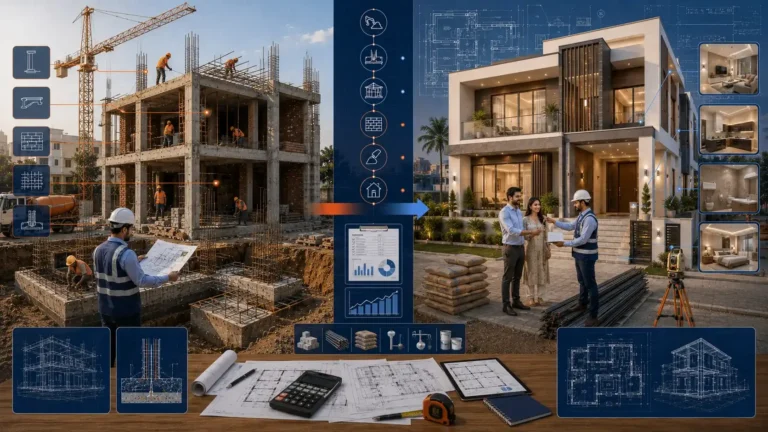
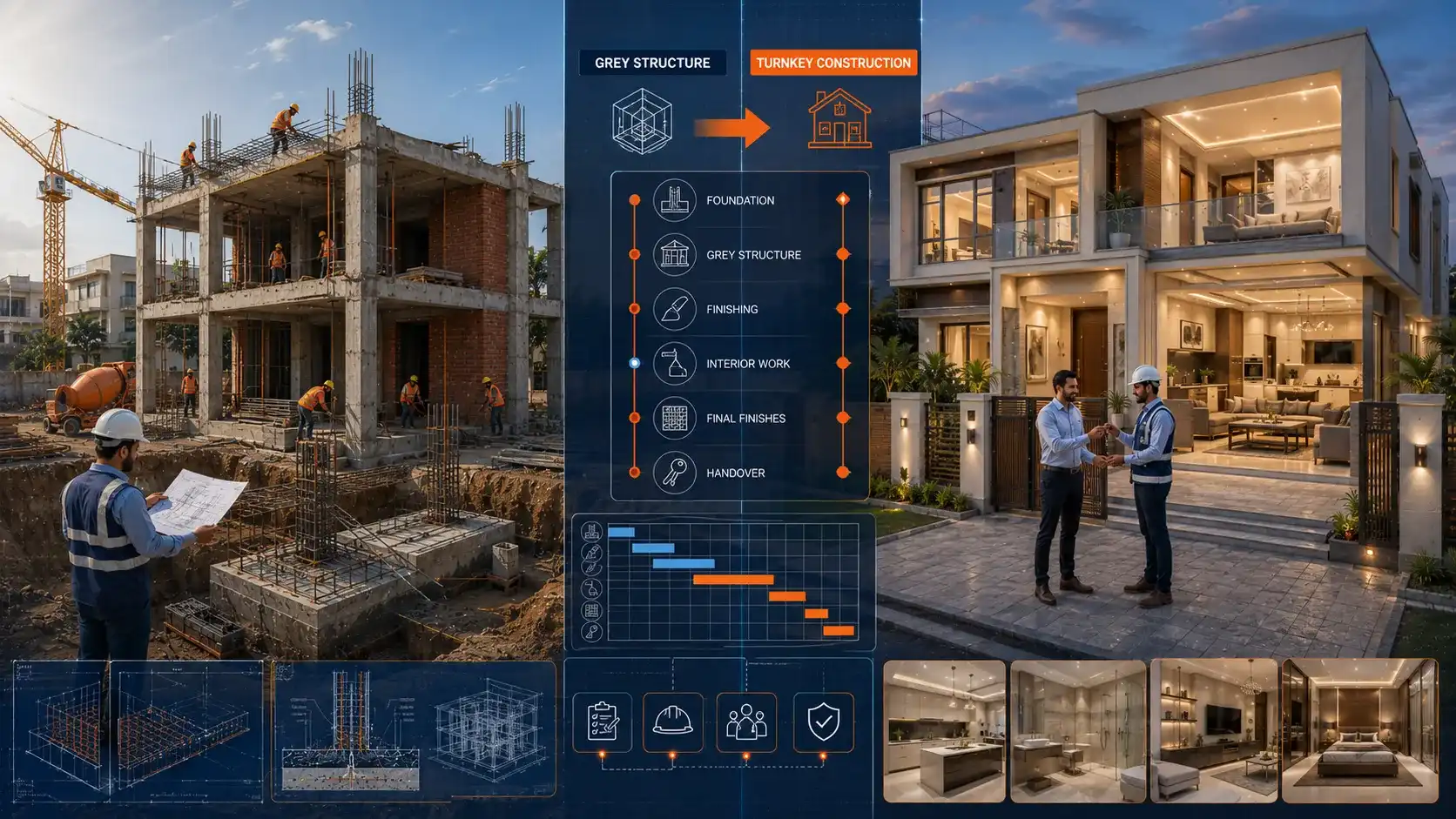
Grey structure construction gives a property owner the building shell — foundation, columns, slabs, brickwork, and roof — while finishing work is arranged separately. Turnkey construction covers the entire project from foundation to move-in-ready finishes under one contract. Advanced Engineering & Construction delivers both models in Karachi under PEC Licence No. 17347, Category C4/E, for projects up to Rs. 200 million. The right choice depends on budget structure, how much control the owner wants over finishing decisions, and how the project will be financed in stages.
Quick Comparison
| Factor | Grey Structure | Turnkey Construction |
|---|---|---|
| Scope | Foundation, columns, slabs, brickwork, roof | Full build including finishing, fixtures, fittings |
| Contractors involved | One for structure, separate ones for finishing | One contractor for entire project |
| Upfront cost | Lower per contract | Higher per contract |
| Total cost (structure + finishing combined) | Often close to or above turnkey once vendors are added | Fixed and consolidated |
| Control over finishing materials | High — owner selects every vendor | Lower — contractor manages selection within agreed spec |
| Timeline | Structure completes faster; finishing scheduled separately | Longer overall but continuous, no handoff gaps |
| Best suited for | Phased budgets, owners with a designer or existing vendor network | Owners wanting one handover date, single accountability |
| Common in | Private residential builds with staged financing | Commercial projects, busy owners, institutional turnkey tenders |
What Grey Structure Construction Actually Covers
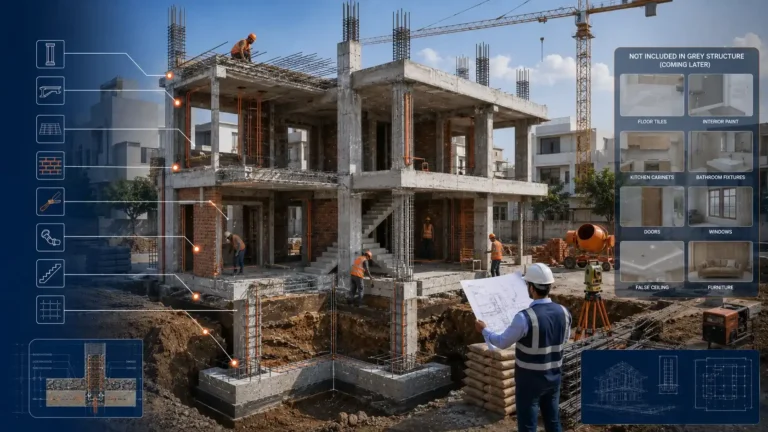
Grey structure work ends at the point where a building is structurally complete but not livable. This includes excavation, foundation, RCC columns and beams, slabs, brick or block masonry, and the roof. Plumbing and electrical conduit are typically laid inside the structure at this stage, but fittings, flooring, paint, doors, and fixtures are not included.
What’s included in grey structure:
- Excavation and foundation
- RCC columns, beams, and slabs
- Brick or block masonry
- Roof structure
- Embedded plumbing and electrical conduit (pipe-in-wall stage only)
What’s excluded from grey structure:
- Flooring, tiling, and marble work
- Paint and wall finishes
- Electrical and plumbing fixtures
- Doors, windows, and carpentry
- Kitchen and bathroom fittings
A property owner who chooses grey structure separately hires finishing contractors afterward — painters, flooring installers, electricians for fixtures, and carpenters — either directly or through a second contract. This model suits owners who want to release finishing budgets over time, and it gives direct control over every finishing material and vendor.
What Turnkey Construction Covers
Turnkey construction bundles grey structure and every finishing trade into one project under one contractor. The property owner receives a completed, move-in-ready building without managing separate vendors for flooring, painting, electrical fixtures, kitchen fittings, or bathroom finishing. AEC’s turnkey scope draws on its full specialization list — twenty-six PEC codes spanning civil, electrical, and mechanical works — so structural, electrical, and finishing trades run under one project timeline instead of three separate ones.
This model suits owners who want a fixed handover date and a single point of accountability. Coordinating five or six contractors across a build takes time most working professionals do not have.
Cost Breakdown: Grey Structure vs Turnkey in Karachi
| Cost Element | Grey Structure Only | Turnkey (All-Inclusive) |
|---|---|---|
| Structural work (foundation to roof) | Included | Included |
| Flooring and tiling | Not included — separate contract | Included |
| Paint and wall finishes | Not included — separate contract | Included |
| Electrical and plumbing fixtures | Not included — separate contract | Included |
| Kitchen and bathroom fitting | Not included — separate contract | Included |
| Project management across trades | Owner coordinates separately | Single contractor manages all |
Grey structure in Karachi typically runs lower per square foot than turnkey, since it excludes flooring, paint, fixtures, and fittings entirely. Turnkey rates sit higher because finishing materials and labor are priced into the same contract. Both figures vary by plot size, number of floors, soil conditions, and the finishing grade selected. Neither figure is fixed — an accurate estimate requires a site visit rather than a blanket rate.
Which One Costs More Overall
Turnkey construction usually costs more as a single contract value, because it includes labor and materials that grey structure leaves out. Grey structure alone costs less initially, but the combined cost of grey structure plus separately hired finishing work often lands close to, or above, a turnkey quote once vendor markups and coordination delays are factored in. Owners who manage finishing well themselves, with existing contacts for tile, paint, and electrical work, can sometimes save against turnkey pricing. Owners without that network typically end up paying more in total through the grey-structure-plus-separate-finishing route than they would have through turnkey.
Which Option Fits Your Project
| Choose Grey Structure If | Choose Turnkey If |
|---|---|
| Budget will be released in phases | Priority is a fixed handover date |
| A designer or architect already manages finishing separately | No time to manage multiple contractors |
| Owner wants direct control over every vendor and material | Single-point accountability matters more than granular control |
| Tender or procurement structure requires separate contracts (common in SBCA-governed institutional projects) | Institutional client prefers a single contract award for faster execution |
Why AEC for Either Model
AEC operates under PEC Licence No. 17347, Category C4/E, covering civil, electrical, and mechanical works up to Rs. 200 million in project value. The company has delivered projects for institutional clients including NED University of Engineering & Technology, Jinnah Sindh Medical University, SZABIST, PWD, and PDMA — work spanning both structural and full-finish scope depending on the client’s procurement model. Twenty-six PEC specialization codes mean the same company can move a project from foundation to fixtures without handing off between separate contractors for structural, electrical, and finishing work.
To discuss which model fits your project, call +92-320-1176827 or email Advancedengineeringc@gmail.com. AEC’s office is at Office 34, Decent Towers, Block 15, Gulistan-e-Johar, Karachi, and site visits can be arranged for a project-specific quote for either scope.
Frequently Asked Questions
Is grey structure cheaper than turnkey construction?
Grey structure costs less as a standalone contract, since it excludes finishing materials and labor. Once separate finishing contracts are added afterward, total cost often comes close to a turnkey quote for the same building.
Can I start with grey structure and switch to turnkey later?
Yes. Many owners complete grey structure first and hire the same or a different contractor for finishing once budget or design decisions are settled. AEC can quote either stage independently or as a combined project.
Does AEC’s PEC licence cover both grey structure and turnkey projects?
PEC Licence No. 17347, Category C4/E, covers civil, electrical, and mechanical works up to Rs. 200 million, which includes both structural-only and full turnkey scope within that project value.
How long does a turnkey project take compared to grey structure alone?
Turnkey projects take longer overall since they include finishing trades, but they avoid the gaps between hiring separate contractors that often stretch a grey-structure-plus-finishing timeline.
Which model do government and institutional clients usually choose?
It depends on the procurement structure. Some tenders separate structural and finishing scope under Sindh Building Control Authority requirements, while others award a single turnkey contract for faster execution.