Last June, a friend in Gulshan sent me his electricity bill with one line circled in red pen: Rs. 47,000, mostly air conditioning, for a two-bedroom flat with the AC running maybe ten hours a day. He wasn’t even running it in the master bedroom. That’s the summer most Karachi households are living through now — heatwaves that used to be rare are becoming the baseline, and the box in the wall that’s supposed to fix it is quietly bankrupting people.
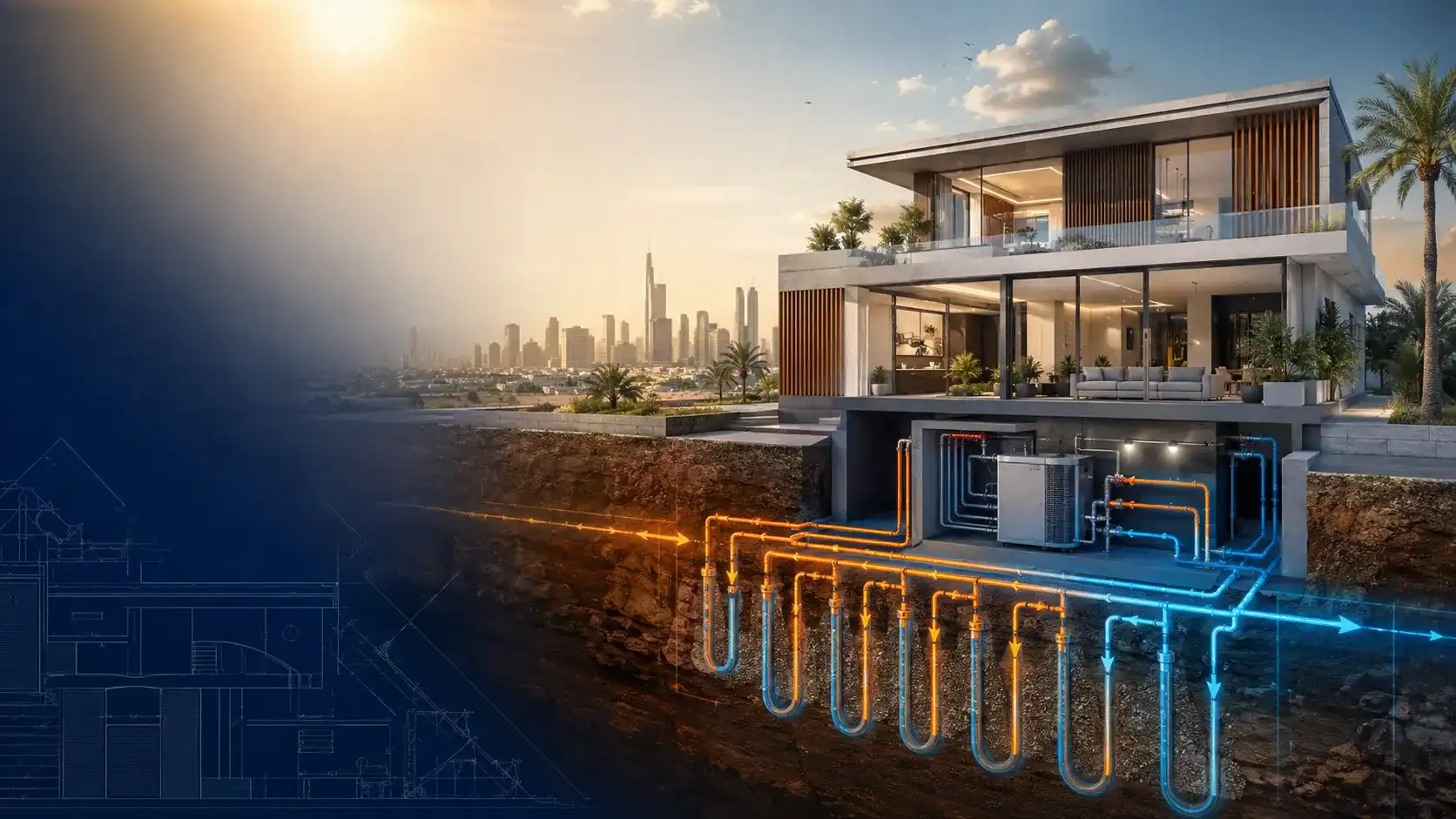
Here’s what nobody tells you: the ground under that flat is already the temperature his AC is straining to reach. Eight to twelve feet down, Pakistani soil sits at a stable 21 to 25 degrees Celsius year-round, whether it’s 45°C outside or 8°C. A Pakistani company called GeoAirCon has built a system that taps into that stability using underground pipe loops instead of a compressor fighting the outside air. And it’s not a lab prototype. It’s already running in buildings across the country, quietly, while almost nobody in the construction or renovation industry is talking about it.
That’s the gap this article is going to close.
What Geothermal Cooling Actually Means (No Jargon Version)
Conventional AC works against the weather. It pulls heat out of your room and dumps it into 45-degree air outside, which is like trying to pour water uphill. The compressor burns enormous energy doing that.
Geothermal cooling instead runs a loop of fluid-filled pipes underground, using heat pumps to move heat from the building down into the stable earth instead of into the hot air. In winter, you can literally reverse the process and pull warmth back out of the ground. Same buried pipes, both seasons — which is honestly the part that made me sit up when I first read about it, because most “green” building tech is single-purpose. Techxlab
The physics isn’t new. Ground-source heat pumps have existed since the 1940s in colder countries. What’s new is somebody adapting the concept for Pakistan’s soil, budgets, and rooftop realities.
Meet the Pakistani Company Already Doing This
GeoAirCon describes itself as Pakistan’s first indigenous provider of ground-source climate control, and it didn’t come out of a multinational R&D lab. It started at the National Incubation Center in Islamabad, working specifically on integrating ground cooling into the AC loop to cut electricity use for air conditioning by up to half.
The numbers, as of the most recent reporting: the company has installed over 120 tons of combined cooling and heating capacity so far, with systems operating in twelve buildings around Pakistan. Their flagship project isn’t a mansion in DHA — it’s a hostel at Namal University in Mianwali, keeping 100-plus students comfortable through summers where outdoor temperatures hit 50°C. Altogether more than 500 people are currently living or working under GeoAirCon systems spread across the country.
That’s a genuinely small footprint next to the millions of conventional AC units sold in Pakistan every year. But small and invisible aren’t the same thing. Twelve buildings with real performance data is twelve more than most people assume exist.
The Money Question: What Does It Actually Cost?
This is where most articles about “the future of cooling” go soft and vague. Let’s not do that.
A GeoAirCon system costs somewhere between 260 and 460 US dollars to install — call it roughly PKR 75,000 to 130,000 at current exchange rates, though that will move with the rupee. Running costs come in significantly below a conventional AC unit, and separately, the company claims a 35 to 75 percent cut in overall climate-control costs depending on the building and system type.
Here’s the contrarian bit I’d push back on if I were a skeptical client: that installation cost sounds almost too cheap for anything involving underground drilling. The honest answer is that it’s cheap specifically because of a very Pakistan-specific trick — the systems can use boreholes and personal water wells that already exist on many properties, rather than requiring a fresh drilling operation. If your plot doesn’t already have a borehole, your real installation cost climbs, and nobody selling you the technology will volunteer that upfront.
The company’s own founder has been candid that a building’s insulation quality heavily determines how well the system performs, so this isn’t a drop-in replacement you bolt onto a poorly built house and expect miracles from.
Why Isn’t Everyone Already Talking About This?
Fair question, and I don’t think the answer is “the technology doesn’t work.” A few more boring reasons explain the silence:
It needs to be planned at construction or major renovation stage. You can’t easily retrofit buried pipe loops into a finished, tiled, landscaped property without ripping things up. That immediately shrinks the addressable market to new builds and gut renovations — which is a smaller, slower sales cycle than “buy a split AC this weekend.”
It’s a three-person company, not a corporate rollout. GeoAirCon operates out of Islamabad with a small team, which means marketing reach in Karachi specifically is close to zero. Nobody’s running billboard campaigns for this.
The scale of the actual problem is staggering, and one small startup can’t cover it alone. Researchers connect this directly to public health: extreme heat contributed to 568 deaths in Pakistan over just six days in June 2024, while demand for air conditioning is projected to triple by 2050 — even though roughly 80 percent of households in the region can’t currently afford conventional AC at all. That’s not a niche efficiency upgrade problem. That’s an access-to-survivable-cooling problem, and geothermal is one candidate answer among several, not a finished solution.
Where Could This Realistically Work in Karachi?
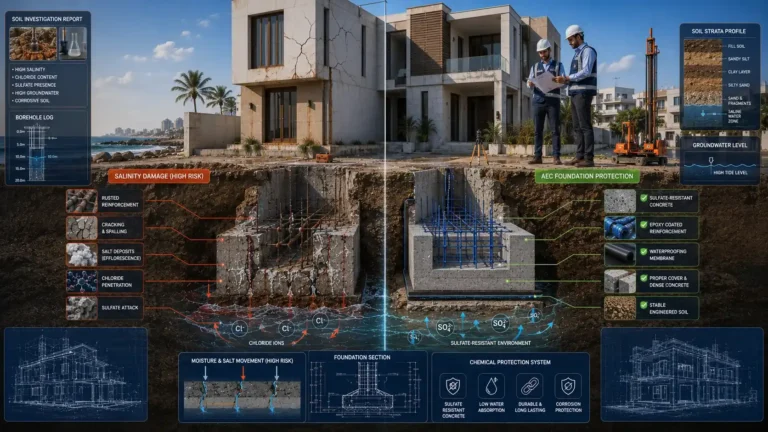
Karachi’s soil and water table are different from Islamabad’s, so I’d flag this honestly rather than assume it transfers one-to-one. Coastal and reclaimed land areas — parts of DHA, Clifton, and the newer developments near the coast — have higher water tables and different soil salinity, which changes how a ground loop performs compared to Islamabad’s terrain.
That doesn’t rule Karachi out. It means anyone seriously considering this needs a site-specific assessment, not a copy-pasted spec sheet from a hostel in Mianwali. Independent villas with a garden or open plot — common in Gulshan-e-Iqbal, PECHS, North Karachi, and parts of Scheme 33 — are the more obvious early candidates, since they typically have the outdoor space for the loop without needing to dig under an existing structure.
If you’re planning a new build or a full renovation in Karachi this year, this is exactly the kind of thing worth raising with whoever is managing your civil works before foundations go in — not after. It’s a five-minute conversation at the design stage and a much bigger, messier one afterward. Karachi-based contractors like Advanced Engineering & Construction are the kind of firm that conversation would happen with, since ground-loop planning has to be coordinated with the civil and plumbing scope from day one, not added as an afterthought.
The Honest Catch List
I’d rather tell you where this falls short than oversell it.
- It’s unproven at Karachi’s building density. All the public case studies so far are in Islamabad and rural Punjab, not a dense urban plot.
- It needs land access. The company says installation is possible in dense areas with under a meter of width needed for the borehole, but that’s still a physical constraint apartment buildings and tight commercial plots don’t easily accommodate.
- Long-term maintenance data is thin. A system installed in 2022 hasn’t been through a decade of monsoons yet. Anyone telling you otherwise is guessing.
- It’s not a replacement for basic passive cooling. Insulation, shading, and window placement still do most of the work; geothermal is the last 30 percent, not the first.
Geothermal vs Conventional AC vs Solar-Powered Cooling
| Factor | Conventional Split AC | Solar-Powered AC | GeoAirCon (Geothermal) |
|---|---|---|---|
| Upfront cost | Low (Rs. 60k–150k per unit) | High (panels + inverter + AC) | Moderate (~Rs. 75k–130k, higher without existing borehole) |
| Running cost | High, grid-dependent | Low once installed, weather-dependent | Low, largely weather-independent |
| Works during load-shedding | No | Partially, with battery backup | Depends on pump power source |
| Retrofit-friendly | Very (plug-and-play) | Moderate | Poor (needs ground access at construction/renovation stage) |
| Track record in Pakistan | Decades | Growing steadily | Early stage, small but real |
| Best suited for | Existing built homes | Off-grid or high-solar-exposure sites | New builds, plots with open ground or existing boreholes |
None of these wins outright. They solve different problems for different property types, which is the actual takeaway more than any single “winner.”
What Should You Actually Do If You’re Building or Renovating This Year?
If you own an independent plot with a garden or borehole, ask a contractor at the design phase whether a ground loop is physically and financially viable for your soil type — don’t wait until the structure is finished. If you’re in an apartment or a tightly packed plot with no outdoor ground access, geothermal probably isn’t realistic yet, and your money is better spent on insulation, shading, and a solar-assisted setup instead. Either way, treat any cost or savings number quoted to you as a starting estimate tied to your specific site, not a fixed promise — that’s true of this technology and honestly true of every renovation quote you’ll ever get.
Frequently Asked Questions
Is geothermal cooling actually available in Pakistan right now, or is this theoretical?
It’s real and operating today. GeoAirCon has systems running in twelve buildings across Pakistan, including a 100-plus-person university hostel in Mianwali, not a pilot in a lab.
How much does a geothermal cooling system cost in Pakistan?
Installation runs roughly 260 to 460 US dollars, though that assumes usable ground access; sites without an existing borehole will cost more due to drilling. Techxlab
Does geothermal cooling work during load-shedding?
Not automatically. The system still needs power to run the circulation pump, so it doesn’t eliminate your load-shedding problem on its own — pairing it with solar or battery backup is where the real resilience comes from.
Can I add this to a house I already built?
Technically sometimes, practically rarely. Ground loops are far easier to install before landscaping and flooring go down, which is why this fits new construction and major renovations much better than a quick retrofit.
Is this only for rich people with big houses?
Not by design — the whole reason this technology exists is that most households in the region can’t afford conventional AC at all — but right now it’s most accessible to plots with outdoor ground space, which does skew toward independent houses over apartments.
Where is this headed next?
GeoAirCon’s own roadmap points to vertically integrating its supply chain in 2025 to bring costs down further, followed by an international push into the Middle East in 2026. Whether Karachi specifically gets meaningful coverage before that expansion is still an open question.
Ten buildings ago, this would have been a footnote. Twelve buildings in, with a university hostel surviving 50-degree summers on buried pipes instead of brute-force compressors, it’s starting to look like the beginning of something Karachi’s next wave of construction can’t afford to ignore at the design table. The bill my friend circled in red pen isn’t going away on its own — but the ground under his flat has been sitting at 22 degrees the whole time, waiting for someone to use it.