Advanced Engineering & Construction designs and installs underground and overhead water tanks for homes across Karachi under PEC Licence No. 17347, Category C4/E. Tank sizing depends on household size, plot area, storage duration, and how reliable the water supply is in that particular locality. For most Karachi homes, the right answer sits somewhere between a 1,000-gallon overhead tank paired with a larger underground reservoir, and a multi-thousand-gallon underground tank sized around tanker delivery schedules rather than daily use alone.
Contact Advanced Engineering & Construction — Grey Structure and Home Renovation in Karachi
Get a Site Visit & Project Quote
Grey structure, home renovation, and full construction services in Karachi — delivered under PEC-licensed supervision.
Why Tank Sizing in Karachi Works Differently
Karachi does not follow the same water tank logic used in cities with a steady municipal supply. The city needs close to 1,200 million gallons of water per day and receives roughly 550 million gallons from all sources combined. That gap means most households store water for days at a time, not hours, and size their tanks around delivery cycles instead of pure daily consumption. A formula built for a city with 24-hour supply will consistently undersize a Karachi tank.
The Pakistan Council of Research in Water Resources places average urban per-capita water use in Pakistan at around 114 litres, or roughly 25 gallons, per day. That figure covers drinking, cooking, bathing, laundry, and flushing combined. A household of five at this rate needs about 570 litres, or 125 gallons, per day just to meet baseline use, before factoring in gardening, car washing, or guests.
The Sizing Formula and How to Apply It
Tank sizing in Karachi starts from one core calculation. Multiply the number of household members by daily per-person consumption, then multiply that figure by the number of storage days you want to cover. Add a 20 to 25 percent buffer for supply delays, sediment settling at the tank base, and unplanned guests.
For a family of five at 125 gallons per day, storing five days of backup water works out to 625 gallons, and with a 20 percent buffer that becomes roughly 750 gallons of usable capacity. Because tankers in Karachi commonly deliver in 1,000, 2,000, 3,000, or 5,000-gallon loads, most contractors round the underground tank up to the nearest tanker size rather than building to the exact calculated figure. This keeps refills efficient and avoids paying for a partial tanker load.
Underground vs Overhead: What Each Tank Is For
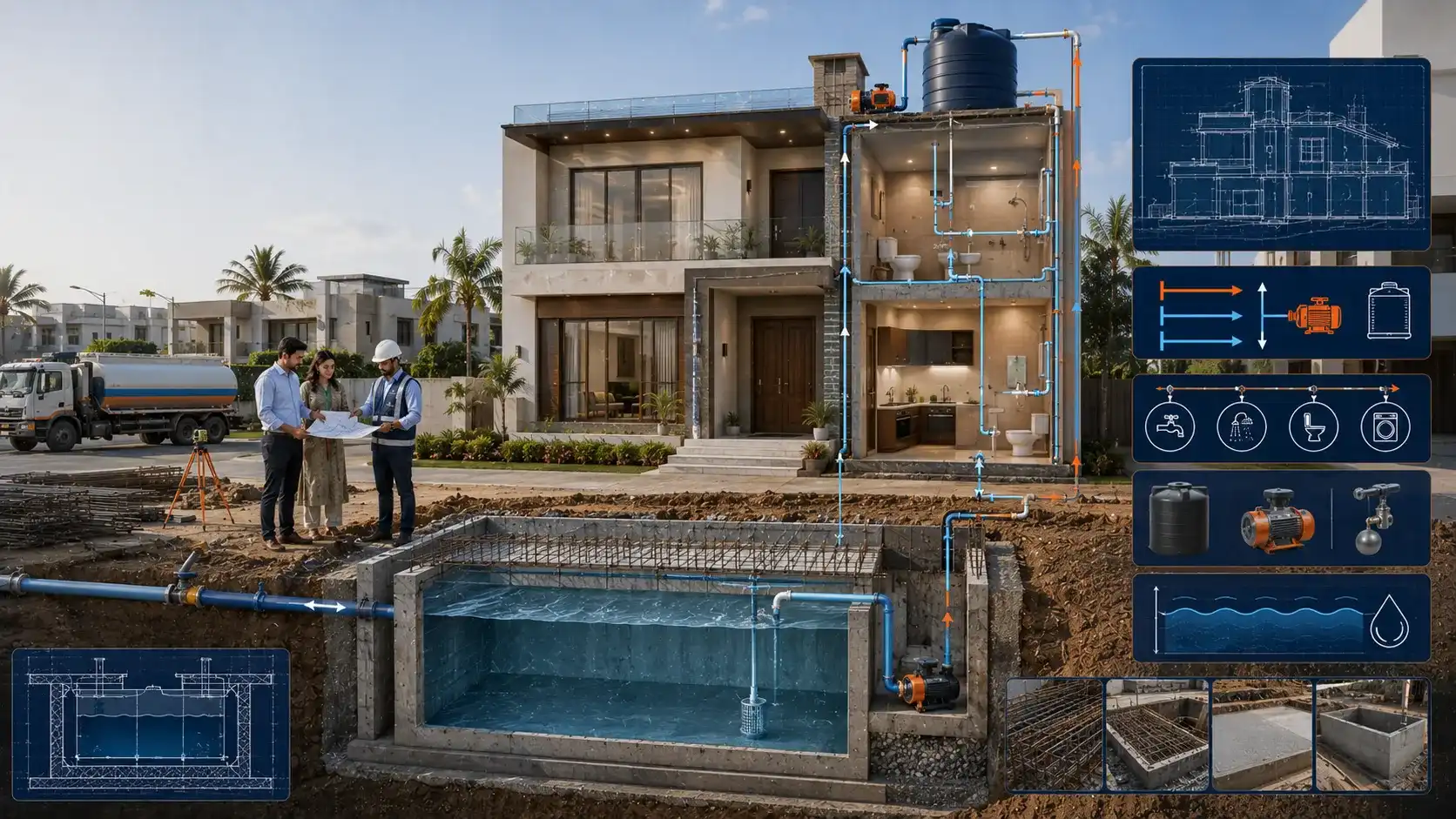
An underground tank and an overhead tank serve different jobs in the same system, and confusing the two is the most common sizing mistake homeowners make. The underground tank is the reserve — it receives water from the mains or a tanker and holds several days of supply below ground, protected from heat and evaporation. The overhead tank is the delivery buffer — it feeds taps and fixtures by gravity and typically only needs one to two days of capacity, since a pump refills it from the underground tank as needed.
For a typical Karachi house, the overhead tank runs between 500 and 1,000 gallons, sized to cover peak morning and evening usage without the pump cycling constantly. The underground tank runs larger, usually 1,000 to 3,000 gallons for a 120 to 300 square yard home, and can extend to 5,000 gallons or more on bigger plots or where tanker supply is irregular. The Karachi Building & Town Planning Regulations 2002 permit underground water reservoirs within the Compulsory Open Space of a plot, which is why most homes place them beneath the front lawn, driveway, or car porch rather than losing covered floor area.
Sizing by Plot Size: A Practical Starting Point
A 120 to 150 square yard home with four to five residents typically works well with a 1,000 to 1,500-gallon underground tank and a 500-gallon overhead tank. A 200 to 300 square yard home with a larger family, or one that maintains a garden, usually needs 2,000 to 3,000 gallons underground and 750 to 1,000 gallons overhead. Homes above 500 square yards, particularly in areas like DHA or Bahria Town with larger lawns and multiple bathrooms, often move to 5,000-gallon underground storage or a dual-tank setup for redundancy during tank cleaning.
These figures are starting points, not fixed prescriptions. Actual sizing should account for the number of bathrooms, whether the household runs a borewell alongside mains or tanker supply, and how consistent water delivery is in that specific block or scheme.
Cost Context for Karachi Homeowners
Underground tank construction cost in Karachi depends on capacity, depth, and whether the tank is built in reinforced concrete or lined with a waterproofing membrane over brick masonry. Material and labour costs scale with excavation volume and reinforcement steel, so a 3,000-gallon RCC tank costs meaningfully more than a 1,000-gallon tank, not on a straight per-gallon basis but closer to it at larger sizes. Site conditions matter too — a tank built near the boundary wall or under a driveway that will carry vehicle load needs a heavier slab than one built in an open lawn.
Overhead tank cost is separate from the underground structure and depends on material choice, most commonly rotomoulded plastic, and on the supporting structure needed to carry the water load safely on the roof. Final pricing for any tank on a specific plot depends on soil condition, access for excavation equipment, and reinforcement requirements confirmed during a site visit.
Getting the Sizing Right the First Time
Underground water tank installation in Karachi typically costs between Rs. 50,000 and Rs. 500,000, depending on capacity, structural material, and site conditions. Homeowners planning a five thousand gallon reinforced concrete tank on a larger plot sit at the higher end of that range. A family building a one thousand gallon tank on a smaller lot sits closer to the lower end.
Why Sizing Should Be Confirmed by a Licensed Contractor
Advanced Engineering & Construction holds PEC Licence No. 17347, Category C4/E, covering civil construction works including water storage structures under specialization codes CE04(iv) for water retaining structures. Tank sizing on paper is only half the job — the tank also has to sit within the plot’s structural and drainage plan without undermining the foundation, boundary wall, or driveway load path above it. A contractor who handles both the civil structure and the plumbing connection can size the tank, the pump, and the pipework as one system instead of leaving gaps between trades.
Get Your Tank Sized for Your Specific Home
Water tank sizing depends on details specific to your plot, your family, and your block’s water supply pattern, which is why a phone estimate is rarely accurate. Advanced Engineering & Construction can visit your site in Karachi, assess soil condition and plot layout, and confirm the right underground and overhead tank combination before construction begins. Call 0320-1176827 or email advancedengineeringc@gmail.com to arrange a site visit, or reach the office at Office 34, Decent Towers, Block 15, Gulistan-e-Johar, Karachi.
Contact Advanced Engineering & Construction — Grey Structure and Home Renovation in Karachi
Get a Site Visit & Project Quote
Grey structure, home renovation, and full construction services in Karachi — delivered under PEC-licensed supervision.
FAQs
How many gallons of water does a Karachi family need per day?
A household of five needs roughly 125 gallons per day at Pakistan’s average urban consumption rate of 114 litres per person. This covers drinking, cooking, bathing, laundry, and flushing. Households with gardens, extra bathrooms, or frequent guests should plan for 20 to 30 percent above this baseline.
What size underground tank does a 200 square yard house in Karachi need?
Most 200 to 300 square yard homes in Karachi use a 2,000 to 3,000-gallon underground tank paired with a 750 to 1,000-gallon overhead tank. Final sizing depends on family size, water supply reliability in that specific area, and whether the home also uses a borewell.
Is AEC licensed to build underground water tanks in Karachi?
Yes. Advanced Engineering & Construction holds PEC Licence No. 17347, Category C4/E, which covers civil construction works including water retaining structures under PEC specialization code CE04(iv). This licence permits AEC to design and construct underground water tanks as part of a home’s civil works.
How much does an underground water tank cost to build in Karachi?
Underground water tank construction in Karachi typically ranges from Rs. 50,000 to Rs. 500,000, depending on capacity, structural material, and site conditions such as soil type and excavation depth. A site visit is needed to confirm an accurate quote for a specific plot.
Should I size my tank around daily use or tanker delivery schedules?
In areas with irregular KWSB supply, size the underground tank around tanker delivery cycles rather than daily use alone, since tankers commonly deliver in 1,000 to 5,000-gallon loads. This avoids partial tanker orders and keeps the household covered between deliveries. Areas with more consistent line water can size closer to true daily consumption plus a smaller buffer.
Can I build a large underground tank anywhere on my plot?
Underground water tanks are generally permitted within the Compulsory Open Space of a Karachi plot, most often under the driveway, car porch, or front lawn. Placement still needs to account for the foundation, boundary wall, and any structural load the tank roof will carry above it. A licensed contractor should confirm placement before excavation begins.