Advanced Engineering & Construction builds foundations and civil structures across Karachi under PEC Licence No. 17347, Category C4/E, accounting for soil salinity and groundwater conditions specific to each site. Karachi’s coastal soil contains sulfate and chloride concentrations that attack concrete and corrode reinforcement steel over time, and the severity varies sharply depending on how close a plot sits to the coastline. A foundation designed without testing for these conditions can show cracking, efflorescence, and rebar corrosion years before it should, even when the concrete work itself looked sound at handover.
Why Karachi’s Coastal Soil Is a Structural Risk
Karachi sits on soil shaped by seawater intrusion, arid climate conditions, and gypsum-bearing rock formations, all of which raise sulfate and chloride levels in the ground. A university study of coastal soil samples across Karachi found sulfate concentrations ranging from 0.04 to 1.09 percent and chloride from 0.001 to 0.44 percent, with the highest readings recorded near Hawks Bay and Mubarak Village and the lowest inland toward Benazir Abad Town. That spread means two plots a few kilometres apart can need entirely different foundation specifications.
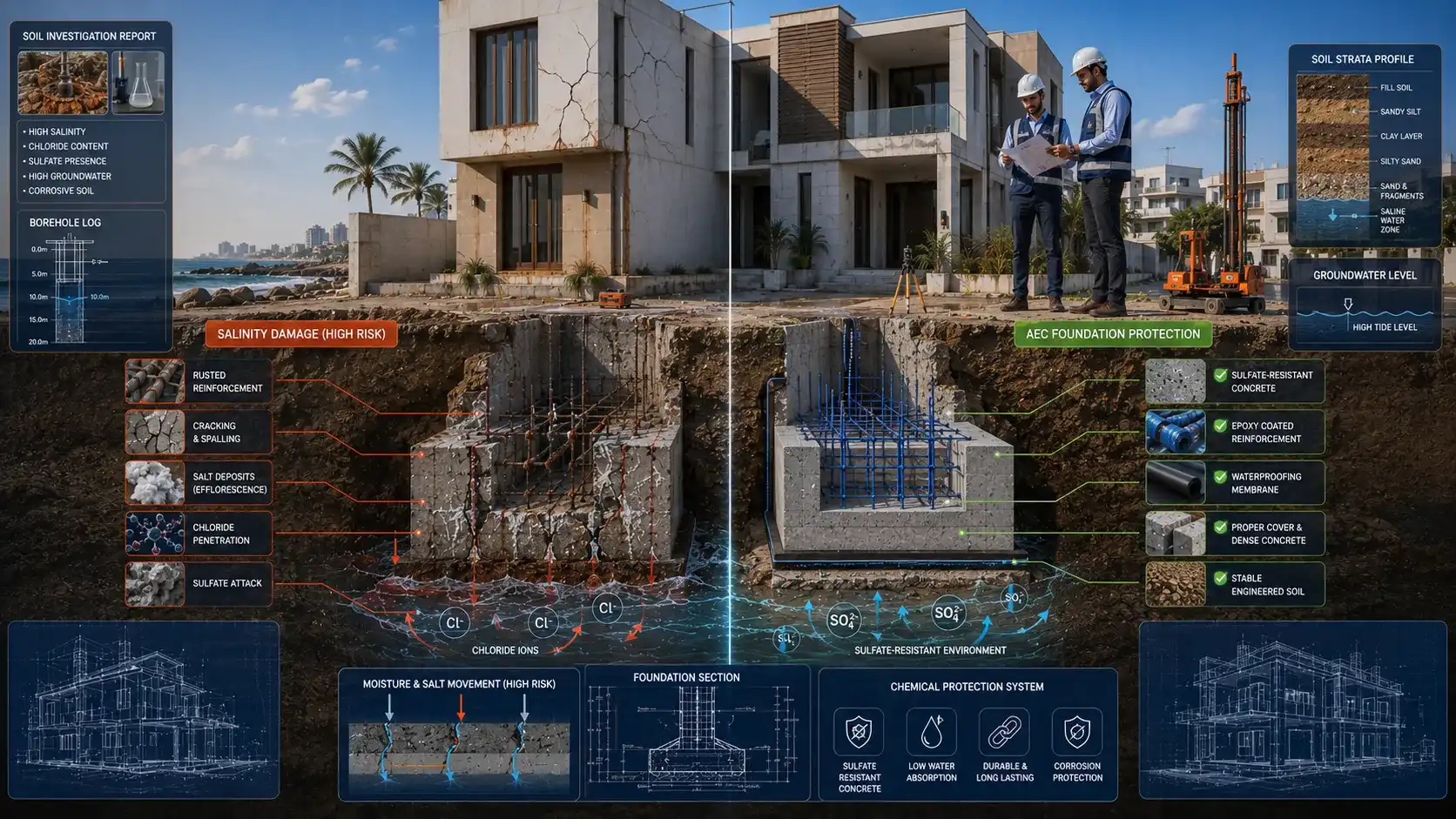
Sulfate ions in the soil react with compounds inside hardened concrete, most significantly tricalcium aluminate and calcium hydroxide, forming expansive crystals inside the concrete’s pore structure. As these crystals grow, they exert internal pressure that shows up first as hairline cracking and a white powdery residue called efflorescence on exposed concrete surfaces. Left untreated, this process reduces bond strength between the cement paste and aggregate, and it can progress to spalling and a measurable drop in structural strength.
Chloride ions cause a separate but equally damaging problem. They diffuse through the concrete cover and reach the embedded reinforcement steel, breaking down the thin protective oxide layer that normally shields rebar from corrosion. Once that layer fails, the steel rusts, expands inside the concrete, and cracks the surrounding cover from the inside out. This is the mechanism behind foundations and boundary walls in older coastal properties that show rust staining and cracking along the reinforcement lines well before the rest of the structure shows wear.
What This Means for Foundation Design in Karachi
The correct response to sulfate and chloride exposure starts with knowing what the soil actually contains before foundation work begins. Soil and groundwater testing at the excavation stage identifies sulfate and chloride concentration at the depth where footings will sit, and that data determines the cement type and concrete mix design used for the foundation. Skipping this step means guessing at protection levels on a site where the wrong guess costs far more to fix after the structure is built than it would have cost to test beforehand.
For plots with elevated sulfate readings, Type II or Type V sulfate-resisting cement provides meaningfully better long-term durability than standard OPC. Where site conditions call for even stronger protection, blending ordinary Portland cement with silica fume or fly ash further reduces the concrete’s vulnerability to sulfate attack. Plots with negligible sulfate exposure, more common further from the coastline, can generally proceed with standard OPC without added cost.
What does soil salinity actually do to a Karachi foundation?
Soil salinity in Karachi causes two distinct forms of concrete damage: sulfate attack, which cracks and weakens the concrete matrix itself, and chloride-driven corrosion, which rusts and expands the embedded steel reinforcement. Both mechanisms originate from seawater-influenced groundwater reacting with the chemical compounds inside cured concrete. Foundations closer to the coastline, including parts of Clifton, DHA, Korangi, and the SITE industrial belt, face measurably higher exposure than plots further inland and require correspondingly stronger cement specification and reinforcement cover.
Reinforcement Cover and Concrete Density Matter as Much as Cement Type
Cement type addresses sulfate resistance, but chloride protection depends more on concrete density and how much cover sits over the reinforcement steel. A lower water-cement ratio produces denser concrete with smaller capillary pores, which slows how quickly chloride ions can reach the rebar in the first place. Increasing concrete cover over reinforcement in high-exposure zones adds a physical buffer that extends the time before corrosion becomes structurally significant.
On sites with a genuinely high water table, waterproofing the foundation and any underground structure becomes as important as the concrete mix itself. A membrane or cementitious waterproofing system applied to footings and basement walls keeps saline groundwater from maintaining constant contact with the concrete surface, which slows both sulfate attack and chloride diffusion. This is a detail that gets overlooked on plots where the water table sits close to the surface for only part of the year, since the risk isn’t visible during a dry-season site visit.
Why AEC Handles Salinity Assessment as Part of Civil Works
Advanced Engineering & Construction holds PEC Licence No. 17347, Category C4/E, covering the full scope of civil construction works including foundation design, reinforcement detailing, and structural concrete. On coastal-adjacent plots, the practical difference between a foundation that lasts and one that needs remedial repair within a decade often comes down to whether soil testing happened before the first footing was poured, not after cracking appeared. A contractor managing both the civil structure and the waterproofing scope can specify cement type, cover depth, and membrane protection as one coordinated plan instead of treating them as separate afterthoughts.
Get Your Site Assessed Before Foundation Work Begins
Soil salinity exposure depends entirely on where your plot sits relative to the coastline and the groundwater table on that specific site, which is why a general estimate cannot substitute for testing. Advanced Engineering & Construction can assess soil and groundwater conditions on your Karachi plot and specify the correct cement type, reinforcement cover, and waterproofing scope before construction starts. Call 0320-1176827 or email advancedengineeringc@gmail.com to arrange a site assessment, or visit Office 34, Decent Towers, Block 15, Gulistan-e-Johar, Karachi.
Contact Advanced Engineering & Construction — Grey Structure and Home Renovation in Karachi
Get a Site Visit & Project Quote
Grey structure, home renovation, and full construction services in Karachi — delivered under PEC-licensed supervision.
FAQs
Does soil salinity affect all areas of Karachi equally?
No. Coastal soil studies show sulfate and chloride concentrations are highest near Hawks Bay and Mubarak Village and drop sharply moving inland toward areas like Benazir Abad Town. Plots in Clifton, DHA, Korangi, and the coastal belt generally face higher exposure than schemes further from the sea, though every plot should be tested individually.
How do I know if my plot needs sulfate-resistant cement?
The only reliable way is a soil and groundwater test at the foundation excavation stage, which measures sulfate and chloride concentration at footing depth. Plots with elevated readings need Type II or Type V sulfate-resisting cement, while low-exposure sites can use standard OPC. Guessing without testing risks either overspending on unnecessary protection or underprotecting a genuinely exposed foundation.
Is AEC licensed to handle foundation work affected by soil salinity?
Yes. Advanced Engineering & Construction holds PEC Licence No. 17347, Category C4/E, which covers civil construction works including foundation design and structural concrete. This licence permits AEC to specify cement type, reinforcement detailing, and waterproofing scope based on site-specific soil conditions.
Does using sulfate-resistant cement cost significantly more than standard cement?
Sulfate-resisting cement and blended mixes with fly ash or silica fume typically cost more than standard OPC, though the difference is a small fraction of total foundation cost on a residential plot. Site-specific pricing depends on soil test results, the quantity of concrete involved, and whether additional waterproofing is also required. A site assessment gives an accurate cost comparison for your specific plot.
Can an existing foundation be treated if soil salinity damage is already visible?
Cracking, efflorescence, or rust staining on an existing foundation usually indicates the damage process has already started and needs a structural assessment before any repair work. Depending on severity, remedial options range from waterproofing and crack injection to more extensive reinforcement and concrete repair. Early assessment costs far less than waiting until structural strength is compromised.
Does a high water table make salinity damage worse?
Yes. Constant contact between groundwater and a foundation accelerates both sulfate attack and chloride diffusion into the concrete, which is why plots with a high or seasonally rising water table need waterproofing in addition to the correct cement specification. This risk is easy to miss on a dry-season site visit, which is another reason soil and groundwater testing matters more than visual inspection alone.