Advanced Engineering & Construction executes civil works across Karachi under PEC Licence No. 17347, Category C4/E. Its site engineering team evaluates lower-carbon concrete options where structural requirements and client budget allow it. Fly ash and ground granulated blast furnace slag are already commercially available in Pakistan. Limestone calcined clay cement, recycled aggregate concrete, and biochar-blended mixes remain research-stage here. None of the three is a product a Karachi contractor can specify off the shelf yet.
Cement production accounts for roughly seven to eight percent of global carbon dioxide emissions. Most of that comes from calcination, the process that turns limestone into clinker. That single fact drives most international research into lower-carbon concrete. For a Karachi client, the more useful question is narrower. Which of these materials can actually go into a project here, and which are still confined to research papers.
Fly Ash Is Already Part of Pakistan’s Concrete Supply
Fly ash is a by-product of coal-fired power generation. It is captured from plant emissions and sold as a partial cement replacement. Pakistan’s coal power expansion over the past decade created a steady domestic supply. Specialist suppliers now distribute it to ready-mix operators in Karachi, Lahore, and Islamabad. Current Pakistani regulation caps fly ash content at thirty percent of cement weight. That limit is set for structural safety, not availability. Within that cap, fly ash improves long-term durability and reduces heat of hydration. Both properties matter during Karachi’s high-temperature summer pours.
GGBS and Slag Cement: Available, But Still a Specialty Order
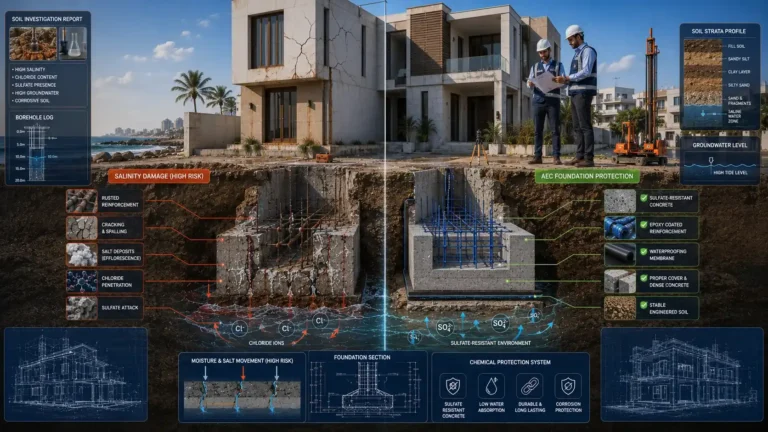
Ground granulated blast furnace slag is a by-product of iron and steel production. It is not produced domestically in Pakistan at meaningful scale. It reaches the local market through specialist importers. These suppliers distribute it alongside fly ash and synthetic gypsum, mainly to ready-mix and precast operators on larger projects. GGBS reduces heat of hydration further than fly ash. It also improves resistance to chemical attack, a genuine advantage on coastal Karachi sites exposed to salt-laden air and groundwater. It remains a specialty order rather than a stock item, which affects lead time and project planning.
Rice Husk Ash: Promising Research, Not Yet Commercial
Pakistan produces large volumes of rice husk as an agricultural by-product, concentrated in Sindh and Punjab. Ongoing research, including work published in 2026, examines rice husk ash combined with fly ash as a pozzolanic material. Early results show real potential for strength and durability gains in structural concrete. No commercial supply chain for construction-grade rice husk ash exists in Pakistan yet. That keeps it in the research category for now, not a specifiable material.
Limestone Calcined Clay Cement: The Raw Material Exists, the Product Doesn’t
Limestone calcined clay cement, known as LC3, replaces a large share of clinker with calcined clay and limestone. It cuts carbon dioxide emissions by roughly thirty to forty percent compared to ordinary Portland cement. Geological research has identified kaolinitic clay deposits in Pakistan suitable for LC3 production. Some of these sites sit near existing Bestway and Askari cement plants. That research confirms the raw material exists here. It does not mean LC3 is available to order for a Karachi project. No Pakistani cement manufacturer currently produces it commercially.
Recycled Aggregate Concrete: Used in Pavement Work, Not Yet Structural
Recycled aggregate from construction and demolition waste can replace twenty to fifty percent of virgin aggregate in concrete. International studies show embodied carbon reductions in the twenty to forty percent range, depending on the replacement ratio used. Pakistani research has tested hybrid recycled brick and concrete aggregate for road sub-base and pavement work. Karachi has no organized construction and demolition waste recycling industry. Most demolition debris is disposed of rather than processed. Recycled aggregate concrete remains a research finding in Pakistan, not a structural material available through standard suppliers.
What This Means for Cost and Project Planning
Fly ash and GGBS are not premium add-ons. Both are by-products. Fly ash in particular is typically priced below the cement it replaces. That can lower material cost within the regulatory replacement limit. GGBS carries a higher cost premium, driven by import logistics and lower order volumes. Final project cost still depends on mix design, structural requirements, and supplier lead times. AEC confirms material availability and pricing at the design stage for each project. It does not quote fixed material rates in advance, since site conditions and structural sign-off vary by project.
PEC-Licensed Execution and Material Decisions
Material substitution in structural concrete is a structural engineering decision, not a marketing choice. AEC’s specialization codes span civil, electrical, and mechanical works under PEC Licence No. 17347. Any change to a concrete mix design goes through the same approval process as the rest of the structural scope. Karachi’s coastal humidity, salt exposure, and monsoon pour conditions all affect whether a material suits a project.
Why AEC Approaches Low-Carbon Concrete Honestly
Most green concrete content written for the Pakistani market repeats global innovations without checking local availability. Biochar, enzymatic carbon-capture materials, and next-generation binders get covered as if they are already on the shelf here. They are not. AEC’s position is narrower and more useful to a client planning an actual project. Fly ash and GGBS are real, sourceable options today. LC3, recycled structural aggregate, and rice husk ash are close, but not yet commercial in Pakistan. A client evaluating a contractor’s sustainability claims should ask which category each proposed material actually falls into.
Advanced Engineering & Construction is based at Office 34, Decent Towers, Block 15, Gulistan-e-Johar, Karachi. The company can be reached at +92-320-1176827 or Advancedengineeringc@gmail.com. Full details on AEC’s civil, electrical, and mechanical works sit on the company homepage at advancedengineering.com.pk.