
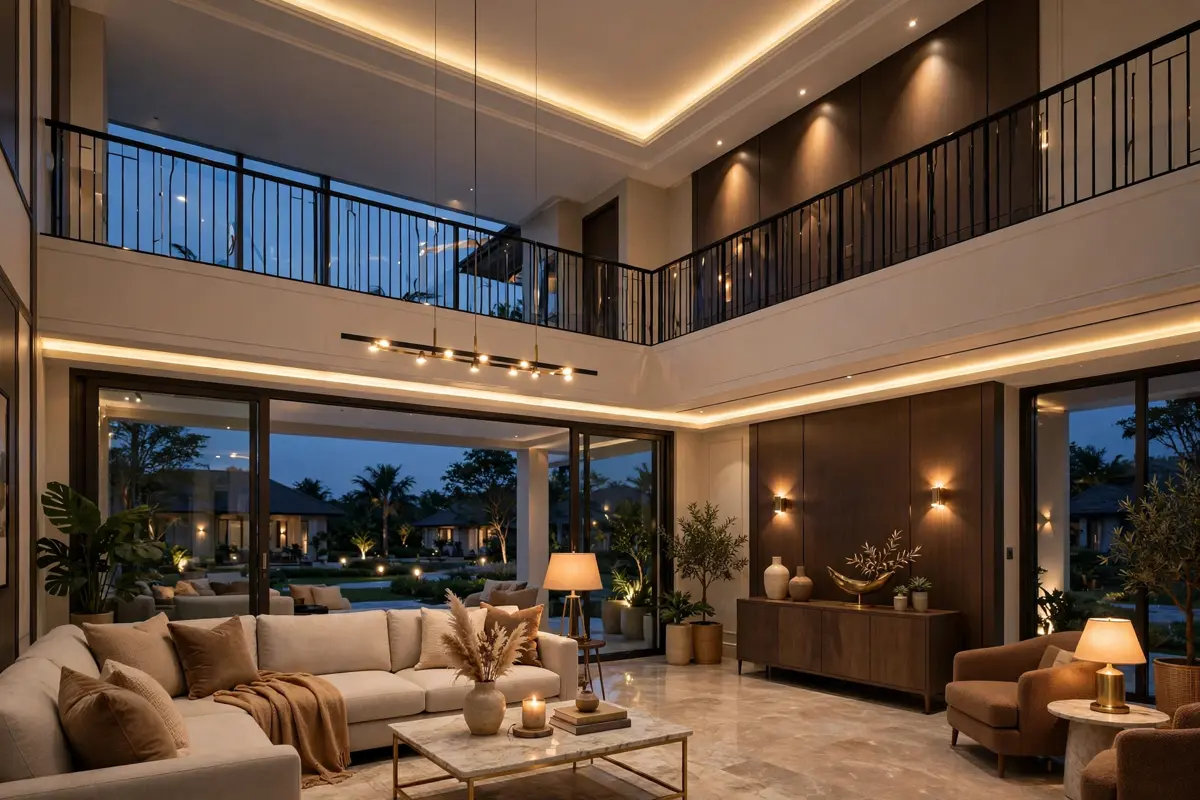
It is 11 at night, and in a DHA bungalow the whole ground floor is still lit in harsh white — the double-height drawing room, the dining space, the lounge, and the bedrooms upstairs. The family blames mobile phones for the poor sleep. Phones are part of it, but half the story is the light: their home’s lighting stays exactly the same all day, while their bodies want different light at different hours.
This article explains what circadian lighting is, how layered lighting works with it, and how to install it practically in a larger Karachi home — without tearing the house apart.
What Is Circadian Lighting, in Simple Words?
Your body has an internal clock that controls sleep, waking, and energy. Its strongest signal is light. Bright, cool morning light tells the body “the day has started”, and dim, warm evening light tells it “time to rest”.
Circadian lighting follows that principle: the colour and brightness of light change through the day. Cool and bright in the morning, warm and dim in the evening. This is not a mood-lighting fashion. In 2022, a consensus paper by circadian scientists (Brown and colleagues, PLOS Biology) put numbers on it: at least 250 melanopic lux at the eye during daytime, under 10 in the three hours before bed, and close to 1 during sleep. Melanopic lux means the light that actually stimulates your circadian cells — not just how bright the room looks.
How Is Circadian Lighting Different From Just Buying a "Warm" Bulb?
A fixed 3000K bulb gives the same light at 7 in the morning and at midnight. That is warm, not circadian.
A real circadian system has three parts. First, tunable white fixtures — able to shift from 2700K (warm) to 6500K (cool daylight). Second, an automatic schedule — because nobody will manually adjust settings every morning and evening. Third, the right intensity — colour alone is not enough; brightness must also be high by day and low at night.
If a shop sells you a “circadian bulb” with no schedule, it is only a tunable bulb. The schedule is what makes the system work.
What Should Your Light Look Like at Each Time of Day?
Here is a simple daily arc that works in most larger Karachi homes:
| Time of day | Light |
|---|---|
| Morning (7–10 am): | bright and cool, 4000–5000K. Bright light in the kitchen, bathrooms, and home office helps you wake up. |
| Midday (10 am–4 pm): | neutral to cool, 4000–5000K, good brightness. For work and study. |
| Evening (4–7 pm): | gradually warming, moving toward 3000K. Soft warm light in the drawing room and lounge. |
| Night (2–3 hours before bed): | warm and dim, 2200–2700K, brightness well down. Only essential lights on. |
| During sleep: | as dark as possible. Only a dim warm night light in corridors and stairwells, if needed. |
Dim-to-warm fixtures are excellent for evenings: as you dim them, the light itself shifts from 3000K toward 1800K, close to candlelight. One slider does two jobs.
What Is Layered Lighting, and Why Does Circadian Need It?
One row of ceiling lights for a whole drawing room is the original problem. Layered lighting means three layers working together:
- Ambient layer: the room’s general light — ceiling downlights or cove light.
- Task layer: light where work happens — kitchen island, study desk, dressing mirror.
- Accent layer: light for mood and design — wall washers, shelf lights, a focus light on a painting or a double-height wall.
The circadian system runs on these layers. In the morning all three are bright and cool; at night only an accent and one dim warm ambient layer remain. That is how a large open-plan space feels energetic by day and restful by night — without changing a single bulb.
How Should Each Space Be Lit?
Primary bedroom and kids' rooms: These benefit the most. Bright cool light in the morning supports waking, and a slow shift to warm-dim over 30–60 minutes before bed prepares you for sleep. Keep bedside lamps warm (2700K) and the harsh ceiling white off at night.
Kitchen: 4000–5000K in the morning and midday, so work at the island and counters does not strain the eyes. Under-cabinet task strips make the biggest single difference here.
Drawing, dining, and lounge: In a larger home these spaces flow into each other. Warm dim ambient plus one or two accent lights in the evening. Raise brightness when guests arrive, otherwise keep it low — a double-height room lit fully at night feels like a showroom, not a home.
Home office or library: 4000–5000K task light by day, with a soft bias light behind the screen to reduce eye strain. Even for late work, shift to warm-dim at night or sleep will suffer.
Bathrooms and dressing areas: Bright neutral light for morning preparation, with light from both sides of the mirror (light only from above casts shadows on the face). Keep a dim warm night option for late hours.
Terrace and outdoor areas: Warm and low in the evening, aimed down, not into neighbours’ windows. Outdoor light should never spill into bedrooms.
What Makes Larger Karachi Homes Different for This?
Four local realities must be part of the plan.
Backup power coordination: Larger homes usually have a generator, UPS, or solar alongside K-Electric. A schedule only works if it survives the switchover — put the lighting circuit and controllers on protected backup, or every power cut resets the schedule.
Large glass and the western sun: DHA and Clifton homes often have big west-facing glass. Without curtains, blinds, or shading, harsh evening sun ruins a warm evening scene and heats the room. Plan shading with the lighting, not after it.
Multiple floors, multiple zones: A ground floor and a first floor should not run one identical schedule. Bedrooms upstairs need an earlier warm-dim shift than a lounge where guests sit late. Zone the house floor by floor.
Dust and high ceilings: Dust settles on fixtures and makes light look dim, and double-height ceilings are hard to reach. Choose fittings that are easy to clean and service, and use quality drivers with surge protection — voltage swings kill cheap drivers first.
What Should You Buy, and What Does It Cost?
Keep the start simple. Most spaces need:
- Tunable white downlights or smart bulbs (2700K–6500K range, CRI 90 or higher so colours look natural)
- An app or controller that can build a sunrise/sunset schedule, zoned floor by floor
- Task strips for the kitchen island and study
- A dim-to-warm bedside option for bedrooms
All rupee figures below are rough market guides only — actual cost moves with inflation, brand, and installer, so get a fresh written quote before you budget. A basic tunable setup for one room generally falls between Rs. 50,000 and Rs. 150,000. A larger home simply has more rooms and zones, so the total multiplies with the number of zones — fixtures, controller, and labour decide the final figure. These are market guides, not an AEC quotation.
What Is the Step-by-Step Plan for Your Home?
- List each space’s layers: ambient, task, accent — what exists and what is missing.
- Zone the house floor by floor, and choose fixtures per layer: check tunable range, CRI, and dimming depth.
- Build the daily schedule: cool-bright mornings, warm-dim evenings, near-dark nights.
- Put lighting circuits and controllers on protected backup and add surge protection.
- Run the schedule for one week, then note the difference in your sleep and morning energy — then adjust timings to your own routine.
Which Mistakes Should You Avoid?
- One cool white light scheme for the whole house — this is the biggest problem.
- Running 6500K “daylight” bulbs at night — the enemy of sleep.
- Buying expensive fixtures with no schedule — the schedule is the real product.
- One identical schedule for two floors — bedrooms and lounges live on different clocks.
- Ignoring CRI — under low CRI, food, clothes, and skin tones all look lifeless.
- A different app and brand in every room — one system, one schedule, or rooms will shift at different times.
Frequently Asked Questions
Does circadian lighting fix sleep?
Lighting supports healthy sleep timing, but it does not treat any medical condition. If a sleep problem persists, consult a doctor.
Can it be installed in an existing bungalow without breaking walls?
Mostly, yes. Smart bulbs and wireless controllers work on existing wiring — only task strips and new circuits need an electrician.
Is the same schedule right for children and elderly people?
The principle is the same, timings differ. Elderly people benefit from brighter morning light, and children’s rooms should go warm-dim strictly at night.
Is this only for expensive smart homes?
No. You can start with one floor or a few rooms and a few smart bulbs. The whole house at once is not required.
Is there any substitute for daylight?
No, and that matters: real daylight is the best circadian signal of all. Artificial light is its partner, not its replacement — especially in the evening and at night.
How Do I Get This Planned for My Karachi Home?
Send your floor plans, their direction, and your daily routine to Advanced Engineering & Construction (AEC) — a lighting plan is built around those, not copied from another home. If you are renovating or building new, include lighting layers and a circadian schedule in your interior design in Karachi plan from day one, so wiring never has to be broken later.
One last question for you: which space in your home stays brightest at night — and is that light keeping you awake?

One Comment