Advanced Engineering & Construction builds and repairs reinforced concrete structures across Karachi’s coastal belt under PEC Licence No. 17347, Category C4/E, covering civil, electrical, and mechanical works up to Rs. 200 million in project value. On coastal and reclaimed land in DHA, Clifton, and Hawke’s Bay, AEC specifies sulfate-resistant cement and epoxy-coated reinforcement instead of standard construction materials. A building three kilometres from the Arabian Sea carries a different load of chemical stress than one built in Gulistan-e-Johar or North Karachi, and a mix design that works inland can fail early on the coast.
Why Coastal Karachi Ages Its Concrete Faster
Karachi’s coastline is not a stable, natural shoreline in most of its developed sectors. Much of DHA’s Phase 8 expansion sits on land reclaimed from Gizri Creek, with satellite records showing the waterway shrinking from roughly 14 square kilometres in 1986 to about 11 square kilometres today. Reclaimed and tidal-origin land holds residual salinity in the soil itself, independent of what blows in off the sea.
Groundwater compounds the problem. Across Karachi, groundwater is largely brackish and sits between 30 and 150 feet depending on the area, a level that has been dropping as older, shallower wells run dry. Large sections of the city, DHA included, were historically tidal plains before reclamation, and ground levels in some pockets sit below sea level. Foundations and basement slabs in these zones sit in near-constant contact with saline moisture, whether or not the building ever floods. The News
Add the sea breeze itself. Chloride-laden air moving off the Arabian Sea settles on exposed concrete, brickwork, and boundary walls in Clifton, DHA, and Hawke’s Bay every day of the year, not only during monsoon season. This is a continuous chemical load, not an occasional weather event, and standard OPC concrete specified for inland Karachi construction was never designed to carry it.
How Salt Attacks Concrete and Steel: The Actual Mechanism
Two separate chemical attacks happen at once in coastal Karachi structures, and each accelerates the other.
Chloride attack on the rebar.
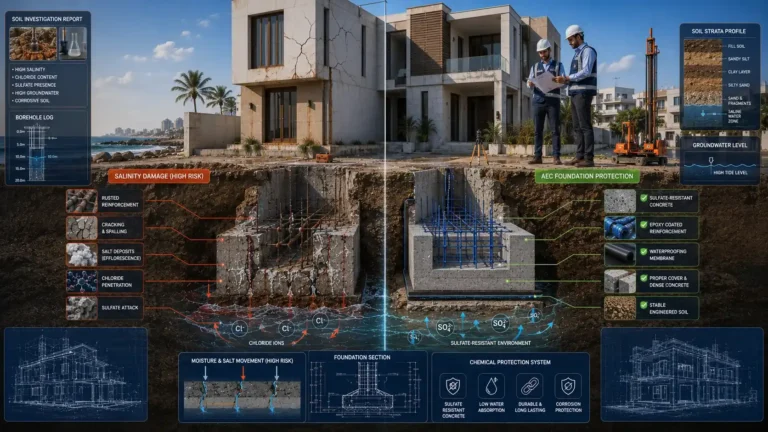
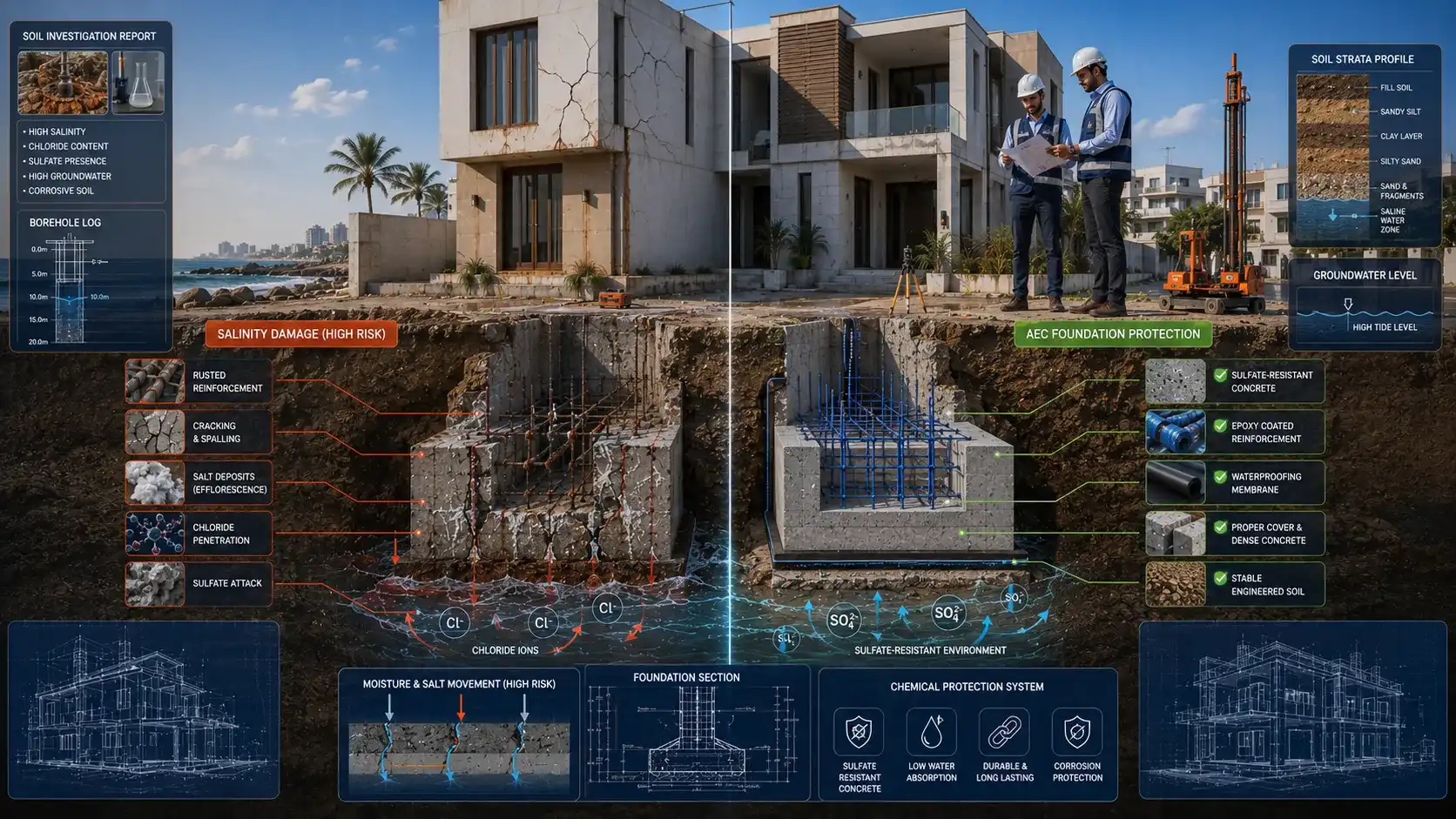
Steel reinforcement sits inside concrete protected by a thin, naturally forming oxide layer that keeps it from rusting. Chloride ions penetrating through the concrete cover break down this protective layer on the rebar surface, which then accelerates the corrosion process. Once corrosion starts, rust forms at roughly two to six times the volume of the original steel, and that expansion pushes outward against the surrounding concrete from the inside.
Sulfate attack on the cement matrix.
Sulfate ions, common in Karachi’s coastal soil and groundwater, react with hydration products inside standard cement paste. This reaction forms expansive compounds within the cement paste that lead to internal expansion, cracking, and a progressive loss of strength.
The two attacks feed each other.
Sulfate ion concentration directly influences how aggressively chloride-induced corrosion attacks the steel bars in offshore and marine-exposed concrete, and sulfate-driven expansion and cracking can accelerate the chloride attack further. A foundation exposed to both, which describes most ground-floor and basement work in DHA, Clifton, and Hawke’s Bay, deteriorates faster than either mechanism would alone.
The visible result: cracking that follows the line of buried rebar, rust bleeding through plaster and paint, and eventually concrete cover falling away to expose corroded steel underneath.
Warning Signs to Check on an Existing Coastal Property
- Hairline cracks running in straight lines, often following where rebar sits below the surface
- Rust-coloured staining bleeding through exterior paint or plaster, especially near ground level
- Concrete cover flaking or spalling away, exposing pitted or rusted steel
- White, powdery salt deposits (efflorescence) on boundary walls, plinth beams, or basement walls
- A hollow sound when tapping plaster near the foundation line
- Cracking concentrated at the plinth beam, parapet, or any area holding standing water after rain
None of these signs demand full demolition on their own. Caught early, most are addressed through targeted repair rather than reconstruction, which matters most for the older bungalows and villas common across DHA and Clifton.
The AEC Solution: Sulfate-Resistant Cement and Epoxy-Coated Reinforcement
Sulfate-resistant cement (SRC). SRC is manufactured with a lower tricalcium aluminate content than ordinary Portland cement, which limits the chemical reaction responsible for sulfate-driven expansion. Major Pakistani manufacturers including DG Khan Cement and Lucky Cement produce dedicated SRC variants, and coastal cities including Karachi and Gwadar are the standard use case for choosing SRC over regular OPC. AEC specifies SRC for foundations, basement walls, retaining structures, and any grade-beam work sitting in direct contact with saline soil or groundwater, executed under PEC specialization code CE04(iv), Water Retaining Structures. Monu
Epoxy-coated reinforcement.
For structural steel exposed to chloride ingress, AEC specifies bars coated to ASTM A775, the governing specification for fusion-bonded epoxy-coated reinforcing bars. The standard requires the bar surface to be cleaned by abrasive blast cleaning to near-white metal before the electrostatic spray coating is applied, with set testing frequencies for coating thickness, continuity, flexibility, and adhesion. The coating works as a physical barrier: it keeps chloride ions from reaching bare steel and breaks the electrochemical circuit that drives corrosion, even where the concrete around the bar eventually cracks.
Supporting measures AEC applies alongside SRC and epoxy rebar:
| Measure | Function |
|---|---|
| Increased concrete cover depth over rebar | Adds physical distance chloride ions must travel before reaching steel |
| Low water-cement ratio mix design | Reduces capillary porosity, slowing chloride and sulfate ion penetration |
| Waterproofing membrane at plinth and parapet junctions | Blocks the entry points where site experience shows water tracks back under a structure fastest |
| Corrosion-inhibiting admixtures where specified | Protects reinforcement from chloride-induced corrosion when compatible with the chosen cement blend. |
On coastal renovation and repair work specifically, the most common failure point AEC finds is not the main wall surface but the termination detail at parapet copings and pipe sleeves, where a missed lap or seal lets saline water track back under an otherwise sound waterproofing system during monsoon pressure.
How AEC Executes Coastal-Grade Construction, Site to Handover
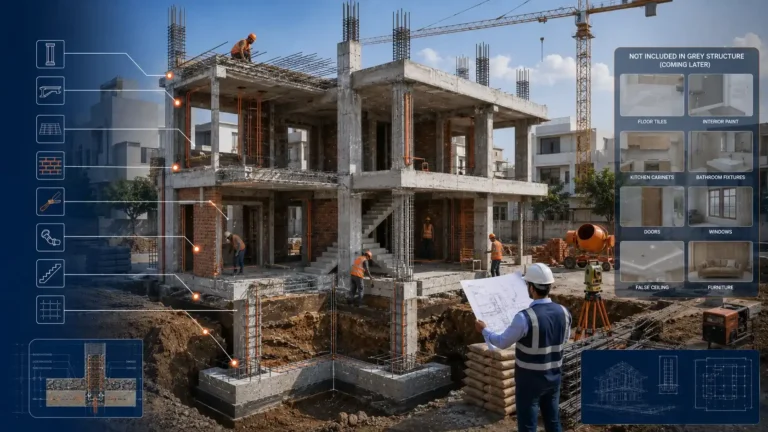
A coastal-grade specification only works if it is followed on site, not just written into a boq. AEC’s process for DHA, Clifton, and Hawke’s Bay projects runs through five stages. Soil and groundwater conditions are checked for salinity before the mix design is finalised, since sulfate and chloride content vary block to block along the coast. Cement type is then locked to SRC for all below-grade and ground-contact elements. Rebar is inspected on delivery for coating damage, and any nick or scrape in the epoxy layer is patched on site with a matching repair compound before placement, since a damaged coating creates a corrosion starting point rather than a barrier. Concrete is placed with verified cover depth using calibrated spacers, not guesswork. Waterproofing membranes go in last, at every junction where two surfaces meet, before backfilling or plastering seals the work from view.
Cost Context: What Coastal-Grade Protection Adds to a Karachi Project
Sulfate-resistant cement and epoxy-coated rebar cost more than standard materials, but the addition sits on top of a construction budget already dominated by cement, steel, and labour. Grey OPC cement in Pakistan currently trades in the range of Rs. 1,300 to Rs. 1,600 per 50-kilogram bag depending on brand and region, and sulfate-resisting cement variants cost more per bag because of the additional processing needed to control sulfate resistance. Epoxy-coated rebar carries a similar premium over uncoated steel, tied to the coating process itself rather than the base steel price. On a typical DHA or Clifton residence, this upgrade adds a modest percentage to the structural material bill, not a multiple of it, and the final figure depends on the building’s footprint, foundation depth, and how much of the structure sits in direct ground or water contact. AEC provides a project-specific material quote after reviewing site drawings and soil conditions, rather than a fixed number that ignores site variation.
Why AEC for Coastal Construction and Renovation in Karachi
AEC operates under PEC Licence No. 17347, Category C4/E, spanning twenty-six specialization codes across civil, electrical, and mechanical works, including CE04(iv) for water-retaining structures. The company has delivered civil and construction work for institutional clients including NED University of Engineering & Technology, Jinnah Sindh Medical University, SZABIST, Pakistan Works & Development (PWD), and the Pakistan Disaster Management Authority (PDMA). Founded in June 2022, AEC handles grey structure work, foundation repair, and waterproofing for both new builds and standing structures across DHA, Clifton, Hawke’s Bay, Gulistan-e-Johar, and the wider Karachi coastal belt, working within the same civil construction service capability that covers grey structure and foundation work citywide.
Renovating an Older Coastal Property?
Bungalows and villas built in DHA and Clifton before coastal-grade specifications became common practice are now showing decades of chloride and sulfate exposure. Renovation work on these properties is the point where corrosion damage is usually first discovered, once plaster comes off during a kitchen extension, bathroom rebuild, or structural repair. AEC’s home renovation service in Karachi includes structural assessment for exactly this reason, checking exposed rebar, foundation cracking, and moisture ingress before any cosmetic finishing work begins.
Get a Site Assessment
Frequently Asked Questions
Does AEC use sulfate-resistant cement on every project, or only near the coast?
AEC specifies SRC for foundations, basements, and any ground-contact structure in known saline zones such as DHA, Clifton, and Hawke’s Bay. Inland Karachi projects with standard soil conditions are assessed individually, since SRC is a response to confirmed sulfate exposure, not a blanket requirement.
What is the real difference between sulfate-resistant cement and ordinary Portland cement?
SRC is manufactured with a lower tricalcium aluminate content, which limits the chemical reaction that causes sulfate-driven expansion and cracking in standard cement. Ordinary Portland cement performs well inland but degrades faster in soil or groundwater carrying high sulfate content.
Is epoxy-coated rebar necessary for a normal two-storey house in DHA or Clifton?
For ground-floor slabs, foundations, and any structural element in contact with soil or groundwater, yes, since these are the elements most exposed to chloride ingress. Upper-floor structural steel away from ground contact carries lower risk and can often use standard rebar.
How much does coastal-grade construction add to the total project cost?
Sulfate-resistant cement and epoxy-coated rebar add a modest percentage to the structural material bill, not a multiple of it, since both materials cost more per unit but form only part of the total build. AEC provides an exact figure after reviewing site soil conditions and structural drawings.
Is AEC PEC-licensed to carry out water-retaining and coastal structural work?
AEC holds PEC Licence No. 17347, Category C4/E, which includes specialization code CE04(iv) for water-retaining structures alongside general civil, electrical, and mechanical codes. This licence covers project values up to Rs. 200 million.
How can I tell if my existing coastal property already has salt-related damage?
Look for rust staining bleeding through paint near ground level, cracks running in straight lines along buried rebar, and white powdery salt deposits on boundary walls or plinth beams. A site inspection confirms the extent of damage below the visible surface.