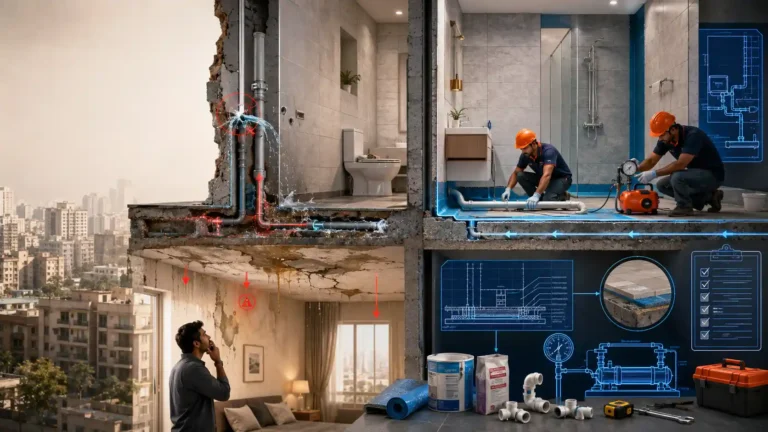
Somewhere in Karachi right now, a homeowner is staring at a damp ceiling stain two years after paying for “complete waterproofing” on a bathroom renovation. They used a reputable brand. They paid a fair price. And the seepage came back anyway.
Here’s the thing almost nobody explains before that call gets made: waterproofing doesn’t fail because of the chemical. It fails because of where the chemical stopped.
I want to walk through this properly, because the gap between “waterproofing was done” and “waterproofing actually worked” is one specific technical detail, and it’s the same detail that gets skipped on budget bathroom builds across this city over and over again.
Contact Advanced Engineering & Construction — Bathroom Renovation in Karachi
Plan Your Bathroom Renovation — Get a Free Site Visit
AEC handles bathroom renovations in Karachi from design to handover — plumbing fixtures, wall and floor tiling, waterproofing, and complete remodels under PEC-licensed supervision.
What Does Bathroom Waterproofing in Karachi Actually Cost?
Bathroom waterproofing in Karachi runs between PKR 150 and PKR 350 per square foot, depending on whether you’re treating a sunken slab from scratch during new construction or repairing an existing bathroom with active seepage. New construction sits at the lower end since the slab is open and accessible. Renovation work costs more because tile and screed have to be broken out first.
That’s a wide range, and the reason it’s wide isn’t marketing flexibility. It’s genuinely two different jobs.
New Construction: The Cheaper, Easier Scenario
New construction sunken slab waterproofing, applied before tiling as part of the original build, typically lands at PKR 150 to 250 per square foot. That figure covers surface preparation, the membrane or cementitious coating itself, and coving at the wall junction — a detail we’ll come back to, because it’s the whole story here. This is the lowest-cost scenario simply because the slab is sitting there open. No demolition, no tile removal, nobody breaking into finished work to get access.
Renovation: Where the Cost — and the Problem — Actually Lives
Renovation waterproofing on a bathroom already showing active seepage runs PKR 250 to 350 per square foot, and the jump isn’t arbitrary. Existing floor tiles, screed, and often the sunken fill material itself have to be broken out before the slab underneath can even be inspected, let alone treated and rebuilt. You’re not just adding a coating at this point. You’re undoing someone else’s shortcut first.
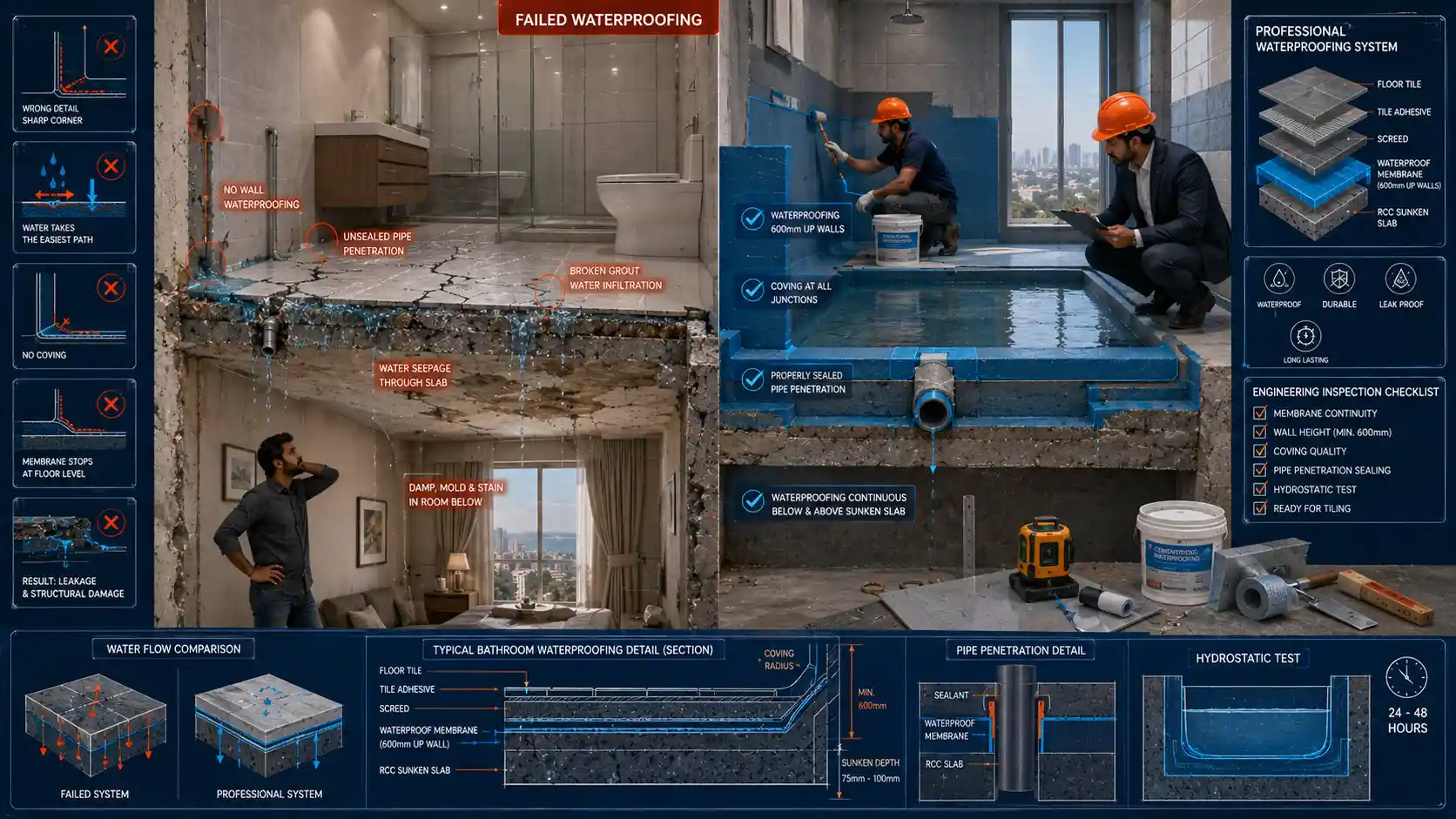
A water ponding test — flooding the treated area and leaving it for 24 to 48 hours to confirm nothing leaks before retiling — should be standard on every single job at this stage. It adds a bit of time. It doesn’t meaningfully add cost. If a quote skips this step, that’s worth asking about directly.
One thing worth flagging separately: underground water tank waterproofing and roof waterproofing get priced apart from bathroom work, since they deal with different surfaces, different hydrostatic pressure, and different membrane systems entirely. If you’re planning both, ask for itemized quotes. A single blended rate covering unrelated scopes is an easy way to lose track of which area actually got proper treatment.
Why Most Bathrooms Leak From the Wall, Not the Floor
The floor-wall junction, not the flat floor surface, is where most bathroom leaks in Karachi actually originate. Water pools at the base of a shower or sink, finds the seam where vertical and horizontal surfaces meet, and tracks downward through hairline gaps that tiling alone can’t seal.
This is the misconception I run into constantly, and it’s an understandable one. If you picture water damage, you picture it soaking down through a floor. That mental image is wrong for a bathroom, and it’s exactly why so many waterproofing jobs treat the wrong surface with total confidence.
Waterproofing applied only to the flat floor area, without running up the wall to at least 600 millimetres above the sunk level, fails even when the chemical itself is genuinely high quality. The coating has to run as one continuous, unbroken layer — across the floor, up the vertical wall junction, and around every pipe penetration. A job that stops neatly at the floor edge has already left the single most vulnerable point on the entire job completely untreated. It’s not a partial job. It’s a job that skipped the part that mattered most.
What’s a Sunken Slab, and Why Does It Matter This Much?
A bathroom floor sits on what’s called a sunken slab — cast roughly 150 to 230 millimetres lower than the rest of the house’s floor level, specifically to make room for drainage pipes and the trap sitting below the floor finish. This sunken section is the highest-risk leakage zone in the entire bathroom. It sits in direct, constant contact with standing water and plumbing penetrations, and once tiling is complete, it’s the single hardest area in the whole room to inspect again.
Waterproofing this properly means sealing the concrete surface, sealing every pipe penetration passing through it, and sealing the vertical junction where floor meets wall — all before the slab gets filled and the floor finish goes down. Pipe and drain positioning needs to be finalized before any of this happens, since sealing around a pipe that gets moved or repositioned afterward defeats the entire treatment. You can’t waterproof around a plumbing decision that hasn’t been made yet.
Coving: The Detail That Separates a Job That Lasts From One That Doesn’t
Coving means forming a curved angle between floor and wall instead of a sharp one, applied at this same stage. Sharp corners crack under thermal movement, plain and simple, and they become the very first point of failure once the bathroom’s in use.
Skipping coving to save time is one of the most common shortcuts on budget bathroom builds across Karachi. It’s cheap to skip and invisible once tiled over — which is exactly why it gets skipped so often. It also shows up as seepage within one to two years, almost like clockwork.
What Karachi’s Climate Adds to the Equation
Karachi’s monsoon season puts sustained pressure on any waterproofing system that wasn’t properly terminated at parapet walls, pipe penetrations, and floor-wall junctions. Here’s the part that surprises people: the failure point in most Karachi waterproofing jobs isn’t the membrane material breaking down. It’s the lapping detail at these termination points — where incorrect overlap lets water track back underneath the system during heavy rainfall, even while the flat surface coating looks completely intact from above.
Older Karachi construction adds another layer to this. Buildings predating modern SBCA-compliant designs often have sunken slabs that were never properly waterproofed at the time of construction at all. Renovating one of these bathrooms means treating the slab as entirely new work, not assuming the original layer offers any residual protection — decades-old cementitious coatings have typically failed long before any visible symptom shows up on the surface.
And here’s the opinion I’ll state plainly, because I think it gets buried under brand marketing constantly: material quality matters less than most homeowners assume, and application technique matters more. A premium imported coating applied without proper surface prep, correct slope toward the drain, and continuous coving at the wall junction will fail faster than a standard cementitious system applied correctly. Most waterproofing quotes in Karachi don’t explain this, because explaining it honestly would mean discussing technique instead of just naming a brand on a sheet of paper.
What a Proper Waterproofing Job Actually Looks Like
Every sunken slab AEC treats gets sealed at the floor, at the vertical wall junction to a minimum of 600 millimetres, and at every single pipe penetration — followed by a water ponding test before any tile work begins. That sequence runs on every new bathroom build and every renovation, under PEC Licence No. 17347, Category C4/E.
For renovations where seepage has already damaged the ceiling below, the diagnostic step matters as much as the fix itself. Identifying whether the failure started at the slab, the wall junction, or a plumbing penetration — before recommending a repair — is what separates a lasting fix from a temporary patch that quietly resurfaces the following monsoon season. Re-coating a visible surface without finding the actual source is just delaying the same phone call by a year.
What to Actually Ask For in a Waterproofing Quote
A proper quote should spell out exactly what’s included: surface preparation, the wall junction height being treated, pipe penetration (plumbing contractors in Karachi ) sealing, coving, and whether a water ponding test is part of the scope. If a quote names only a chemical brand and a flat per-square-foot rate, with no mention of the application sequence, that’s the quote most likely to bring you back to square one within a year or two. Ask what happens at the wall junction specifically. That single question filters out most of the shortcuts this article’s been describing.
Get a Plumbing Quote — Free Site Assessment Included
AEC delivers plumbing works in Karachi for new construction, renovation, and institutional projects — water supply, drainage, and sanitary installation across commercial and government contracts, under PEC-licensed supervision.
Frequently Asked Questions
How much does bathroom waterproofing cost in Karachi?
New construction sunken slab waterproofing typically costs PKR 150 to 250 per square foot. Renovation waterproofing on an existing bathroom with active seepage runs PKR 250 to 350 per square foot due to the demolition and slab rebuild involved.
Why does my bathroom leak even after waterproofing was done?
Most failures happen because the waterproofing membrane or coating stopped at the floor edge instead of extending up the wall junction, or because pipe penetrations weren’t properly sealed. The floor-wall junction, not the flat floor area, is where most bathroom leaks in Karachi originate.
Is AEC licensed to carry out waterproofing and bathroom construction in Karachi?
Yes. Advanced Engineering & Construction holds PEC Licence No. 17347, Category C4/E, covering civil works including bathroom construction and waterproofing, valid through June 2027.
What is a sunken slab and why does it need waterproofing?
A sunken slab is the section of bathroom floor cast 150 to 230 millimetres lower than the surrounding floor to accommodate drainage pipes and the trap below the floor finish. It carries constant moisture and concealed plumbing, making it the highest-risk leakage zone in the bathroom if not properly sealed before tiling.
How long does bathroom waterproofing last in Karachi?
Properly applied waterproofing with correct surface preparation and wall junction coving typically lasts 8 to 15 years, depending on the system used. Failures within 2 to 3 years almost always point to incomplete application at the wall junction or pipe penetrations, not product failure.
Is a water ponding test actually necessary, or is it just an upsell?
It’s necessary, not an upsell. Flooding the treated area for 24 to 48 hours before retiling is the only real way to confirm the waterproofing holds before it disappears under permanent tile — skipping it just moves the discovery of a failure to after the room’s already finished.