A written construction contract fixes scope, cost, and timeline before a single brick moves, and it is the only document that holds up when a project goes wrong. Advanced Engineering & Construction (advancedengineering.com.pk) works under PEC Licence No. 17347, Category C4/E, and puts every Karachi project under a signed agreement before mobilising labour. A verbal promise, however detailed it sounded on a phone call, carries almost no weight once a dispute over cost, quality, or delay needs to be proven.
Why a Verbal Agreement Falls Apart the Moment a Dispute Starts
An oral agreement can still count as a contract under Pakistan's Contract Act 1872, provided there was an offer, acceptance, and consideration. The problem shows up later, not at signing. Once a disagreement reaches a lawyer, the burden falls on the client to prove exactly what was promised, and a phone call leaves no record of the agreed rate, the material grade, or the completion date.
Pakistan's evidence law generally limits how far oral testimony can go in contradicting or adding to a written document, which means a signed contract becomes the reference point a court or arbitrator actually works from. Without one, both sides are left arguing over memory. The contractor remembers a lower spec, the client remembers a higher one, and there is no paper to settle it.
What a Written Construction Contract in Karachi Must Include
A contract that actually protects both sides covers more than a total price. It needs to answer every question a dispute would raise, before the dispute happens.
| Clause | What It Should Specify |
|---|---|
| Scope of work | Exact description of work, room by room or phase by phase, with material brands and grades named |
| Contract value | Fixed price or rate per square foot, broken down by phase, not one lump figure |
| Payment schedule | Payments tied to verified milestones reached, not to calendar dates |
| Timeline | Start date, phase completion dates, and a penalty clause for delay beyond an agreed margin |
| Change order process | How any scope change gets priced, approved in writing, and signed by both parties |
| Material specification | Brand, grade, and quantity for cement, steel, tiles, and fittings |
| Retention money | Percentage held back until the defects liability period ends |
| Defects liability period | How long the contractor remains responsible for fixing defects after handover |
| Contractor credentials | PEC licence number, category, and the scope that licence actually covers |
| Dispute resolution | Arbitration clause, governing law, and where a claim would be filed |
| Termination terms | Conditions under which either side can exit, and what happens to money already paid |
| Signatures | Both parties' CNIC numbers, witness signatures, and the date |
A contract missing even three or four of these still leaves room for the kind of dispute a written agreement was supposed to prevent.
How This Gap Gets Exploited Against Overseas Pakistanis Specifically
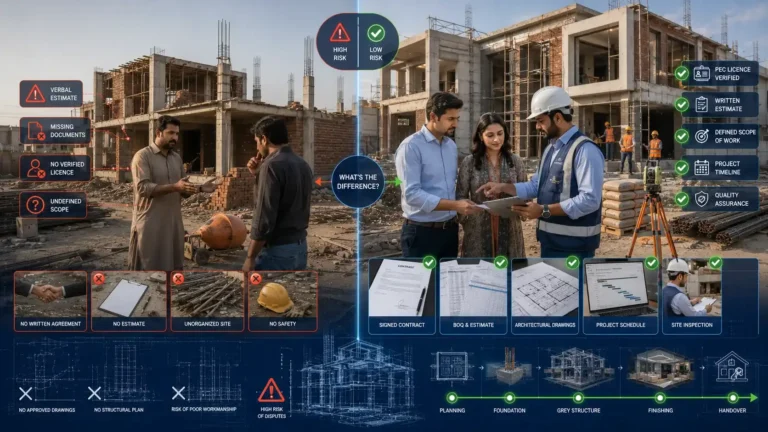
The pattern shows up again and again in complaints involving overseas Pakistanis funding a house or a renovation from abroad. The owner cannot inspect the site in person, so the agreement gets made over a phone call or a voice note, often through a relative or a local contact acting as go-between. Money moves in lump sums against verbal promises, not against verified milestones.
Without a written scope of work, a contractor can substitute cheaper material, skip a stage, or change the layout, and the owner has no document to point to when they eventually see the site. Distance also makes enforcement harder. Pursuing a claim from abroad usually means arranging a power of attorney, engaging a local lawyer, and returning to Karachi at some point, all of which a verbal-only arrangement makes slower and costlier.
What to Verify Before You Sign Anything
A signature on a contract is only worth as much as the contractor behind it. Before committing funds, confirm the following:
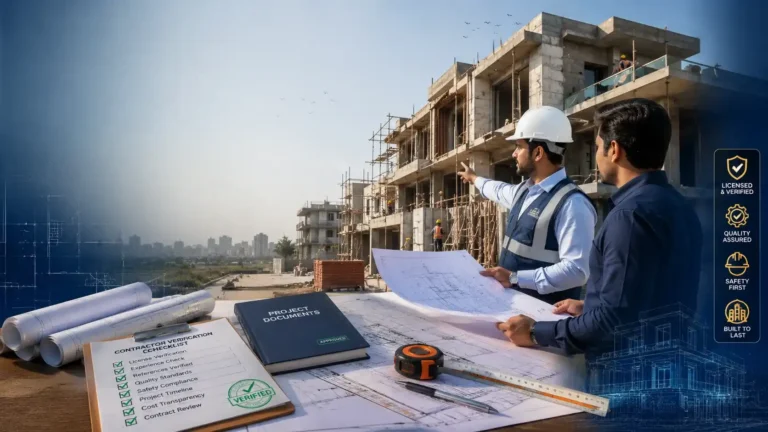
- The contractor's PEC licence number and category, checked against PEC's own registered firms database, not just a claim on a business card
- Whether the licence category actually covers the type of work being contracted, since a category built for civil works does not automatically cover electrical or mechanical scope
- At least one completed project the contractor can show, ideally one the owner or a trusted representative can visit
- The office address on the contract matches a real, checkable location, not just a mobile number
How Payment Schedules and Retention Money Should Work
Payments should follow verified progress, not the calendar. Releasing thirty percent at foundation completion, for example, only works if someone confirms the foundation is actually complete before the payment goes out. Paying against dates alone removes that check entirely.
Retention money commonly runs between five and ten percent of the contract value in Pakistani construction practice, held back until the defects liability period closes. This protects the client against defects that only appear after the contractor has left the site, such as leaks after the first monsoon or cracks after the structure settles. The exact percentage and the length of the liability period should be written into the contract itself, not left as an informal understanding.
What Happens When a Dispute Reaches a Lawyer or Arbitrator
A written contract with a dispute resolution clause gives both sides a defined path forward instead of an open-ended argument. Most Karachi construction contracts specify arbitration before litigation, since it moves faster than the civil court system and keeps the dispute out of the public record. The clause should name the arbitration mechanism, the city where it takes place, and which law governs the agreement.
Without that clause, a dispute defaults to the civil courts, where construction cases can run for years before resolution. A contractor who never signed anything specific also has far less to lose by simply disappearing, since there is no document tying them to the agreed scope in the first place.
Why AEC Puts Every Project Under a Signed Contract
AEC operates under PEC Licence No. 17347, Category C4/E, covering projects up to Rs. 200 million in construction cost, and that licence is checkable through PEC's own registry rather than taken on trust. Every project, whether a single-room renovation in Gulistan-e-Johar or an institutional job, starts with a written scope of work, a payment schedule tied to milestones, and a named point of contact. The company's PEC scope and category are stated in writing before any deposit is requested, not summarised verbally over a call.
Get a Written Scope of Work Before You Commit
Before paying an advance to any Karachi contractor, ask for a written scope of work, a payment schedule, and the contractor's PEC licence number in writing. To discuss a project with AEC directly, call +92-320-1176827, email Advancedengineeringc@gmail.com, or visit the office at Office 34, Decent Towers, Block 15, Gulistan-e-Johar, Karachi
Frequently Asked Questions
Is a verbal construction agreement legally valid in Karachi?
Under the Contract Act 1872, an oral agreement can be legally valid if it has an offer, acceptance, and consideration. The practical problem is proof. Once a dispute starts, there is no document showing what was actually promised, which makes the agreement difficult to enforce even where it is technically valid.
What percentage of the contract value should be held as retention money?
Retention money commonly runs between five and ten percent of the total contract value in Pakistani construction practice. The exact figure varies by project and should be fixed in writing, along with the length of the defects liability period it covers.
How do I verify a contractor's PEC licence before signing a contract?
PEC maintains a registered firms database that lists licence number, category, and validity, searchable directly through PEC's official website. Checking the licence there, rather than relying on a claim made during a sales call, confirms both that the firm is registered and what scope of work its category actually covers.
What should I do if a contractor asks for full payment upfront?
A request for full payment before any work starts is a common warning sign, particularly in agreements arranged from overseas. A milestone-based schedule, where each payment follows verified progress on site, gives the client a way to stop paying the moment work does not match what was promised.
Can I still get legal recourse if I only have WhatsApp messages, not a signed contract?
Message threads can support a claim, but they rarely establish the full scope, price, and timeline the way a signed contract does. They work best as supporting evidence alongside a written agreement, not as a replacement for one.
Does AEC provide a written contract for every project, regardless of size?
Yes. Every AEC project, from a single-room renovation to an institutional contract, starts with a written scope of work, a payment schedule tied to milestones, and the company's PEC licence details stated in writing before any advance is requested.